Gold and Silver record their worst fall in decades: What triggered the historic crash? Explained
The once-relentless rally in gold seems to have suddenly and violently come to a halt. After soaring nearly 32 per cent in January, gold suffered the largest two-day crash in Indian history, with prices plunging by over Rs 18,000 per 10 grams for 24-carat gold. What played out over the last 48 hours was not a routine correction but a brutal reset that shattered months of speculative excess. Silver, which had vastly outpaced gold during the rally, collapsed even harder. After exploding nearly 71 per cent in January alone, silver prices in India crashed close to 20 per cent in just two days, marking their steepest-ever decline. The precious metals boom, fuelled by geopolitical anxiety and easy-money assumptions, ran headfirst into macroeconomic and technical reality. What really crashed the global gold and silver rally Contrary to popular narrative, the crash was not triggered by peace breaking out in Ukraine or tensions easing in West Asia. The geopolitical backdrop remains intact. What changed was market positioning, monetary expectations, and investor behaviour; once those shifted, the fall was inevitable. Data from Bloomberg underscored just how historic the collapse was. Gold prices had jumped over 17 per cent in January alone before the final-day sell-off, putting the metal on track for its best monthly performance in years. That momentum, however, reversed with stunning speed. According to Bloomberg, gold suffered its biggest intraday slide in four decades, while silver recorded its largest intraday decline on record, marking a violent reversal from the rally that had pushed both metals to all-time highs. Gold plunged more than 12 per cent intraday, slipping below the psychologically crucial $5,000 per ounce mark for the first time since the surge, its steepest fall since the early 1980s. The trigger, once again, was macro and monetary. The sell-off coincided with a sharp rebound in the US dollar after reports that the Trump administration was preparing to nominate Kevin Warsh as the next Federal Reserve chair. The prospect of a hawkish Fed leadership immediately undermined sentiment among investors who had piled into precious metals on the assumption that the White House would tolerate, or even encourage, a weaker dollar. That assumption collapsed overnight. The Bloomberg report also highlighted a critical but underappreciated factor: Chinese speculative demand. Chinese investors had been buying precious metals with such intensity that the Shanghai Futures Exchange was forced to rush in measures to cool the surge in both precious and industrial metals. Once global prices turned, that leveraged speculative participation became a liability rather than support, accelerating the unwind. Hawkish Fed signals and dollar rebound break the narrative The first crack appeared when markets began pricing in the possibility that the US Federal Reserve may stay hawkish for longer, prioritising inflation control over asset-market comfort. As expectations of prolonged higher interest rates gained traction, the US dollar rebounded sharply. That alone was enough to destabilise a rally built almost entirely on dollar debasement and falling real yields. A stronger dollar and rising bond yields make non-yielding assets like gold and silver fundamentally less attractive, and once that equation reasserted itself, prices began to wobble. Overbought conditions invite profit booking Gold and silver were already flashing warning signals. Prices had surged far beyond historical norms in a short span, pushing both metals deep into overbought territory. Several market participants had openly cautioned that the rally had become crowded, stretched and one-sided. The moment prices stalled near record highs, large investors began booking profits. In Delhi alone, gold fell by Rs 14,000 per 10 grams in a single session after touching an all-time high of Rs 1,83,000 just a day earlier. Silver followed, dropping Rs 20,000 per kg after hitting a record Rs 4,04,500. What began as rational profit-taking quickly snowballed. Institutional liquidation turns correction into collapse According to commodity analysts, the real damage came when large institutional players aggressively liquidated long positions to lock in gains after the multi-session surge. This sent a clear signal that smart money was exiting. Once heavyweight investors squared off positions, the market’s psychology flipped. Algorithms triggered sell orders, margin calls hit leveraged traders, and ETF outflows accelerated. Liquidity thinned precisely when selling pressure peaked, the textbook setup for a sharp crash. As HDFC Securities’ Saumil Gandhi noted, the decline was driven by a toxic mix of stretched technicals, institutional profit booking, and a strengthening dollar, a combination that rarely ends gently. Panic replaces euphoria With prices falling rapidly, panic set in. Retail and smaller traders rushed to exi
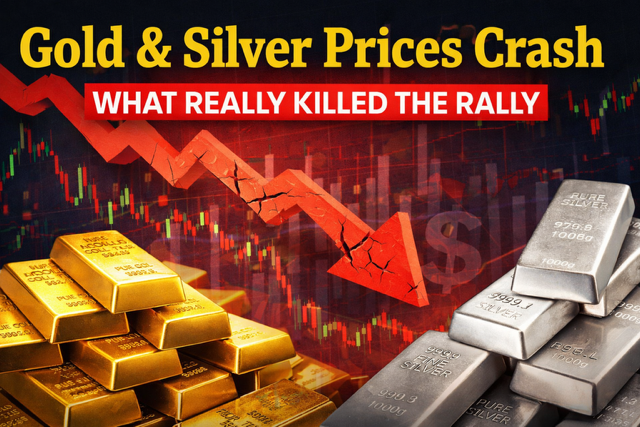

The once-relentless rally in gold seems to have suddenly and violently come to a halt. After soaring nearly 32 per cent in January, gold suffered the largest two-day crash in Indian history, with prices plunging by over Rs 18,000 per 10 grams for 24-carat gold. What played out over the last 48 hours was not a routine correction but a brutal reset that shattered months of speculative excess.
Silver, which had vastly outpaced gold during the rally, collapsed even harder. After exploding nearly 71 per cent in January alone, silver prices in India crashed close to 20 per cent in just two days, marking their steepest-ever decline. The precious metals boom, fuelled by geopolitical anxiety and easy-money assumptions, ran headfirst into macroeconomic and technical reality.
What really crashed the global gold and silver rally
Contrary to popular narrative, the crash was not triggered by peace breaking out in Ukraine or tensions easing in West Asia. The geopolitical backdrop remains intact. What changed was market positioning, monetary expectations, and investor behaviour; once those shifted, the fall was inevitable.
Data from Bloomberg underscored just how historic the collapse was. Gold prices had jumped over 17 per cent in January alone before the final-day sell-off, putting the metal on track for its best monthly performance in years. That momentum, however, reversed with stunning speed.
According to Bloomberg, gold suffered its biggest intraday slide in four decades, while silver recorded its largest intraday decline on record, marking a violent reversal from the rally that had pushed both metals to all-time highs. Gold plunged more than 12 per cent intraday, slipping below the psychologically crucial $5,000 per ounce mark for the first time since the surge, its steepest fall since the early 1980s.
The trigger, once again, was macro and monetary. The sell-off coincided with a sharp rebound in the US dollar after reports that the Trump administration was preparing to nominate Kevin Warsh as the next Federal Reserve chair. The prospect of a hawkish Fed leadership immediately undermined sentiment among investors who had piled into precious metals on the assumption that the White House would tolerate, or even encourage, a weaker dollar.
That assumption collapsed overnight.
The Bloomberg report also highlighted a critical but underappreciated factor: Chinese speculative demand. Chinese investors had been buying precious metals with such intensity that the Shanghai Futures Exchange was forced to rush in measures to cool the surge in both precious and industrial metals. Once global prices turned, that leveraged speculative participation became a liability rather than support, accelerating the unwind.
Hawkish Fed signals and dollar rebound break the narrative
The first crack appeared when markets began pricing in the possibility that the US Federal Reserve may stay hawkish for longer, prioritising inflation control over asset-market comfort. As expectations of prolonged higher interest rates gained traction, the US dollar rebounded sharply.
That alone was enough to destabilise a rally built almost entirely on dollar debasement and falling real yields. A stronger dollar and rising bond yields make non-yielding assets like gold and silver fundamentally less attractive, and once that equation reasserted itself, prices began to wobble.
Overbought conditions invite profit booking
Gold and silver were already flashing warning signals. Prices had surged far beyond historical norms in a short span, pushing both metals deep into overbought territory. Several market participants had openly cautioned that the rally had become crowded, stretched and one-sided.
The moment prices stalled near record highs, large investors began booking profits. In Delhi alone, gold fell by Rs 14,000 per 10 grams in a single session after touching an all-time high of Rs 1,83,000 just a day earlier. Silver followed, dropping Rs 20,000 per kg after hitting a record Rs 4,04,500.
What began as rational profit-taking quickly snowballed.
Institutional liquidation turns correction into collapse
According to commodity analysts, the real damage came when large institutional players aggressively liquidated long positions to lock in gains after the multi-session surge. This sent a clear signal that smart money was exiting.
Once heavyweight investors squared off positions, the market’s psychology flipped. Algorithms triggered sell orders, margin calls hit leveraged traders, and ETF outflows accelerated. Liquidity thinned precisely when selling pressure peaked, the textbook setup for a sharp crash.
As HDFC Securities’ Saumil Gandhi noted, the decline was driven by a toxic mix of stretched technicals, institutional profit booking, and a strengthening dollar, a combination that rarely ends gently.
Panic replaces euphoria
With prices falling rapidly, panic set in. Retail and smaller traders rushed to exit, turning a correction into a rout. In global markets, spot gold fell over 7 per cent intraday, slipping below $5,000 an ounce, while silver plunged as much as 17.5 per cent intraday, after having touched $121 just a session earlier.
This was no longer about fundamentals. It was a positioning unwind, swift, ruthless and indiscriminate.
From manic rally to reality
The collapse does not invalidate gold’s long-term role as a hedge or silver’s industrial relevance. What it destroys is the fantasy that prices can rise endlessly without regard to interest rates, leverage or market structure.
The last two days marked the end of straight-line thinking in the precious metals trade. When rallies become driven by narrative rather than discipline, markets have a brutal way of restoring balance.