Leftists hound Hindu female professor at Jadavpur University over Hijab row: Read how rules are flouted in educational institutions in the name of ‘Islamophobia’
Saswati Halder, head of the English department of Kolkata’s Jadavpur University, has been asked to take a leave of absence until the end of January. The decision was made on 6th January (Tuesday) by Vice-Chancellor Chiranjib Bhattacharjee. The move took place after two students were asked to remove their hijabs during an examination on 22nd December due to suspicions of cheating. They were allegedly frisked by Halder and a research scholar to make sure there were no cheating devices on them. The development transpired one day after a committee appointed by the institution to look into the accusations suggested that the chair of the department be stripped of her duties while the inquiry was underway. “Professor Halder applied for leave for personal reasons. The leave application has been accepted,” the VC claimed. According to reports, she made the request “under pressure” from 7th to 30th January. “The head of the English department was called to the VC’s office at 1 pm on Tuesday and was asked to go on leave until 30th January. The VC reportedly told her students were firm in their demand to remove Halder from her responsibilities until the probe was over. So it is better for her to go on leave,” an official informed. The committee’s chairperson, Syed Tanveer Nasreen, stated that one of the students who appeared before the West Bengal Minorities Commission (WBMC) insisted that several of the questions posed to her were “offensive.” Nasreen mentioned, “When asked about such questions, the teacher said she did this out of naivete.” Colleague crticises the university’s action It was “unfortunate,” according to a professor of the department, that Halder had to take a leave before the committee’s submission of its report along with proposals, and pointed out, “She apologised to the students belonging to a particular community for subjecting them to frisking. She has been frisking students like any other teacher, regardless of their religious or community identity. Still, she was ready to apologise. However, the university administration forced her to go on leave.” The professor highlighted that Halder carried out her duties because they cannot allow pupils to use improper means during exams. “If this goes on, then no one will be ready to carry out the job of frisking. Halder has been left traumatised over the way she was made to go on leave,” she outlined. The department head had already scheduled a meeting for 8th January with the department’s board of studies (BoS). “She requested the VC if she could go on leave after the meeting but was asked to take the leave from Wednesday (7th January) itself,” the senior teacher conveyed. She further expressed, “Halder was extremely disturbed and succumbed to the pressure. She came to the department after meeting the VC, conducted an exam and wrote the email, applying for leave until 30th January.” Background of the controversy During the university’s two-day convocation, some female students from the arts faculty, affiliated with the Students Federation of India (SFI), the youth wing of the Communist Party of India (Marxist), exhibited a poster accusing a section of the department staff of “Islamophobia.” Likewise, some of the English department’s students filed a written complaint with the VC, complaining that the Muslim girls were harassed and singled out under the guise of strict invigilation. They added that the teacher’s action breached their classmate’s constitutional rights and was equivalent to profiling. Afterwards, a six-person West Bengal Minorities Commission delegation visited the campus on 30th December after learning about the incident and met with the vice-chancellor, registrar and student representatives to obtain information regarding the allegations. Imran Ahmed, the chairman of the commission, stated that making pupils take off their headscarves is “completely wrong” and unacceptable. He declared, “Such incidents appear to involve deliberate profiling and such actions have no place in an academic environment.” According to Ahmed, Halde should not be present in the campus until the university committee’s internal investigation has concluded for the sake of an objective and fair inquiry. A three-person fact-finding committee was established by JU to take up the issue and provide a report within a month. However, protests commenced charging the university with violating the fundamental rights of students. The Education Minister Bratya Basu conveyed that the department has taken the instance seriously and would respond appropriately once the minority commission’s report is received. On the other hand, the Jadavpur University Teachers Association (Juta) called on the university administration to create a policy on invigilation during exams. In an internal memo to professors, the group urged faculty members to uphold the “mutual respect between teachers and students” and voiced concerns over cheating and the use of
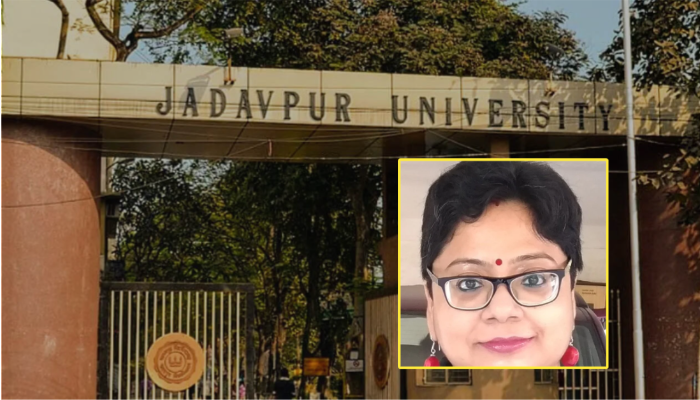

Saswati Halder, head of the English department of Kolkata’s Jadavpur University, has been asked to take a leave of absence until the end of January. The decision was made on 6th January (Tuesday) by Vice-Chancellor Chiranjib Bhattacharjee. The move took place after two students were asked to remove their hijabs during an examination on 22nd December due to suspicions of cheating. They were allegedly frisked by Halder and a research scholar to make sure there were no cheating devices on them.
The development transpired one day after a committee appointed by the institution to look into the accusations suggested that the chair of the department be stripped of her duties while the inquiry was underway. “Professor Halder applied for leave for personal reasons. The leave application has been accepted,” the VC claimed. According to reports, she made the request “under pressure” from 7th to 30th January.
“The head of the English department was called to the VC’s office at 1 pm on Tuesday and was asked to go on leave until 30th January. The VC reportedly told her students were firm in their demand to remove Halder from her responsibilities until the probe was over. So it is better for her to go on leave,” an official informed.
The committee’s chairperson, Syed Tanveer Nasreen, stated that one of the students who appeared before the West Bengal Minorities Commission (WBMC) insisted that several of the questions posed to her were “offensive.” Nasreen mentioned, “When asked about such questions, the teacher said she did this out of naivete.”
Colleague crticises the university’s action
It was “unfortunate,” according to a professor of the department, that Halder had to take a leave before the committee’s submission of its report along with proposals, and pointed out, “She apologised to the students belonging to a particular community for subjecting them to frisking. She has been frisking students like any other teacher, regardless of their religious or community identity. Still, she was ready to apologise. However, the university administration forced her to go on leave.”
The professor highlighted that Halder carried out her duties because they cannot allow pupils to use improper means during exams. “If this goes on, then no one will be ready to carry out the job of frisking. Halder has been left traumatised over the way she was made to go on leave,” she outlined.
The department head had already scheduled a meeting for 8th January with the department’s board of studies (BoS). “She requested the VC if she could go on leave after the meeting but was asked to take the leave from Wednesday (7th January) itself,” the senior teacher conveyed. She further expressed, “Halder was extremely disturbed and succumbed to the pressure. She came to the department after meeting the VC, conducted an exam and wrote the email, applying for leave until 30th January.”
Background of the controversy
During the university’s two-day convocation, some female students from the arts faculty, affiliated with the Students Federation of India (SFI), the youth wing of the Communist Party of India (Marxist), exhibited a poster accusing a section of the department staff of “Islamophobia.” Likewise, some of the English department’s students filed a written complaint with the VC, complaining that the Muslim girls were harassed and singled out under the guise of strict invigilation.
They added that the teacher’s action breached their classmate’s constitutional rights and was equivalent to profiling. Afterwards, a six-person West Bengal Minorities Commission delegation visited the campus on 30th December after learning about the incident and met with the vice-chancellor, registrar and student representatives to obtain information regarding the allegations.
Imran Ahmed, the chairman of the commission, stated that making pupils take off their headscarves is “completely wrong” and unacceptable. He declared, “Such incidents appear to involve deliberate profiling and such actions have no place in an academic environment.” According to Ahmed, Halde should not be present in the campus until the university committee’s internal investigation has concluded for the sake of an objective and fair inquiry.
A three-person fact-finding committee was established by JU to take up the issue and provide a report within a month. However, protests commenced charging the university with violating the fundamental rights of students. The Education Minister Bratya Basu conveyed that the department has taken the instance seriously and would respond appropriately once the minority commission’s report is received.
On the other hand, the Jadavpur University Teachers Association (Juta) called on the university administration to create a policy on invigilation during exams. In an internal memo to professors, the group urged faculty members to uphold the “mutual respect between teachers and students” and voiced concerns over cheating and the use of unjust methods.
Additionally, it argued that the enquiries were objectionable in relation to the religious beliefs of the students and Halder should apologise. The English department’s board of studies also recommended the same.
Halder defends herself
The head of the English department refuted the allegations of Islamophobia and contended that the action was executed due to suspicions of cheating amid the examination. Moreover, a classmate wearing a hood helped to find out if the student was wearing an earbud.
She added that two other hijab-wearing students, including one with a disability, were not ordered to take off their head scarves because the invigilators were not suspicious of their behaviour. The professor stated that the girl who was ordered to partially remove her hijab was led to a vacant room next door and her female batchmate was the only person there to aid her.
The pan India hijab story
The debate regarding the hijab is neither new nor recent. It has periodically arisen in various regions of India, often accompanied by allegations of Islamophobia, to circumvent regulations, incite unrest and amplify trivial matters into major concerns. A hijab controversy rocked the Latin Catholic Church-run Saint Rita’s Public School in Palluruthy of Kerala last year. The institution had to close for two days as a disagreement transformed into a communal dispute.
The reason was a heated altercation that broke out when a girl showed up in an Islamic headscarf, which is not allowed at the school. However, her parents and six other people reportedly caused a commotion on campus and insisted that she be permitted to wear the religious attire.
The Left government ordered the school to yield to the demand, in a prime illustration of the nexus between the “secular” parties and the radical elements of the second-largest community in India. Education Minister V Sivankutty interfered with a politically charged decision and instructed to allow the student to wear hijab and continue her studies, rather than upholding the school’s discretion to maintain order.
Likewise, a massive row began in 2022 when several Muslim students at a college in Karnataka’s Udupi were refused admission to classes due to their hijabs. They were denied access to classes because the college administration noted that the veil is not part of the uniform. Afterwards, Muslim students wore burqas and started an agitation. They even acknowledged consulting with the Campus Front of India (CFI), which is supported by the now-banned Popular Front of India (PFI).
The attorneys for the students invoked “Sharia Law” in the Karnataka High Court to stress that the headscarf is a fundamental religious practice for Muslim women. However, the court determined that it is not an essential practice in Islam and the uniform is a legitimate restriction on the right to religion. The Islamo-leftist ecosystem cast aspersions on the judgement and then it was challenged in the Supreme Court.
A year later, female Muslim students at the government-run Koroimura Higher Secondary School in Tripura’s Sepahijala district caused a stir when they defied school rules by sporting hijabs in class. A group of Hindu boys then protested by donning saffron-colored kurtas. However, the headmaster Priyatosh Nandi stepped in and told all pupils, regardless of faith, to wear school uniforms.
“After a meeting with teachers, I recently directed all students to attend school wearing a proper uniform. However, girl students from the minority community said they cannot follow this directive as wearing hijab is a religious belief,” he expressed. In the meantime, a Muslim student in the tenth grade and his associates vandalised Nandi’s room.
A similar scene unfolded in the same year when protests were held outside NG Acharya & DK Marathe College in Mumbai’s Chembur against the college’s uniform policy. The demonstrations erupted when girls wearing burqas were denied admission by security personnel stationed outside the campus gates because they did not conform to the uniform regulations. Their parents were also present there.
“We held a meeting with parents on the 1st of May to go through this new dress code policy. Everything, including the prohibition on the burqa, the hijab, scarves, and stickers, had been announced. Everyone had agreed to the dress code at the time. However, they are currently protesting,” highlighted principal Vidya Gauri Lele.
The crisis was resolved after police officers arrived and engaged in negotiations with the parents and college management. The college administration in a statement specified that the students would be permitted on the campus with a burqa, hijab, or scarf, but they had to remove it in the restroom before entering the classrooms and could put it back on when they left in the evening.
The hijab has been consistently employed by the members of the Muslim community to flout the rules of educational institutions, only to assert Islamophobia, bring in Sharia law, and characterise the demand to comply with regulations applicable to all students as an assault on their religious identity. This has been evident throughout the years, spanning from the west to the east and from the north to the south, and the occurrence at Jadavpur University is its latest example.
Islamophobia: Handy black cloak utilised to escape responsibility, create controversy
“Islamophobia” serves as a convenient instrument for Islamists and their leftist allies to categorise everything under one umbrella, fabricating issues where none existed at the slightest inconvenience. This is the reason why Jadavpur University, which is otherwise a bastion of liberal and ultra-leftist politics and propaganda, is not immune from supporting the veil, which has resulted in deaths of several Muslim women globally, from Iran to Afghanistan and even in the West.
This should also suffice to comprehend the true nature of their ideology, as they rallied against a teacher who was merely performing her duties, to the point where she not only endured harassment but had also been forcibly sent on leave. It is highly unlikely that Halder would receive a fair trial, considering the rampant Muslim appeasement in West Bengal. Furthermore, the action taken against her is akin to a sword hanging over other teachers who would dare to fulfil their duties.
They might not only hesitate but could also completely refrain from checking or requesting Muslim students to adhere to the rules due to fear of the repercussions, thereby leading to cheating in examinations or breaching the institution’s regulations and norms. The current case has, sadly, established this precedent and further strengthened such troubling elements.