US freezes visas for Pakistani immigrants: Read how Islamabad’s continuous bootlicking has no impact on the Trump administration
On 14th January (Wednesday), the US State Department announced that it will halt the processing of immigrant visas for people of 75 countries, such as Pakistan, Bangladesh, Russia and Iran. The suspension is going to start on 21st January and last indefinitely until the department reevaluates how immigrant visas are processed. The Trump administration mentioned that only immigrant visas that are intended for permanent relocation are impacted by the freeze. Tourist, business and other short-term travel visas would be processed routinely. The Trump administration explained that the move targets nations whose immigrants rely significantly on the country’s welfare systems. The injunction shall remain in effect until the United States ensures that new immigrants won’t put a financial strain on American taxpayers. It might be unexpected to find Pakistan on the list, given the “close ties” shared by the two countries. However, the move is not particularly surprising for those familiar with the longstanding relationship between the countries, and this is merely a continuation of that history. Washington has persistently reduced Islamabad to the role of a vassal state deemed only suitable for executing the directives issued by the former, based on its national and strategic advances in the region in exchange for financial assistance. The Islamic Republic has similarly behaved as a facilitator of the US interests as it received billions of dollars, especially under the guise of the “War on Terror”, while harbouring the terrorists that American forces were seeking in Afghanistan. The two have consistently exploited one another for their benefits; however, this does not detract from the reality that the country has been a servant to US interests since its inception, based on communal lines. Pakistan acts as US doormat during “Operation Sindoor,” endorses Trump’s lies India dismantled terrorist infrastructure deep inside Pakistan during “Operation Sindoor” following Pahalgam terror attack, resulting in global mortification for the nation that attempted to retaliate by targeting civilian areas. However, these plans were swiftly thwarted by the Indian defence forces, which attacked its military installations. Pakistan incurred significant losses, including damage to its bases, leading to further embarrassment that forced it to appeal to Washington, pleading for its intervention to preserve what remained of its already eroded reputation. However, the country was instructed by the US to immediately yield and set up a direct line of communication with the Indian Army. Hence, the desperate “Islamic nuclear power” had to reach out to its neighbour as Major General Kashif Abdullah contacted Lieutenant General Rajiv Ghai on 10th May at 3:35 pm, which was later verified by Foreign Secretary Vikram Misri. Afterwards, President Donald Trump, in line with his self-aggrandising and megalomaniacal nature, left no chance to assert his role alongside the contribution of his tariffs in the ceasefire, despite the Modi government’s repeated refutations. New Delhi pointed out that the development was a consequence of Islamabad’s initiative. India firmly opposed Trump’s misleading claims, while Prime Minister Shehbaz Sharif thanked him for his alleged mediation efforts between the two nations. As if this were not enough, Pakistan also put forth the president’s name for the “Nobel Prize” for resolving disputes among rival nations and promoted his self-claimed reputation as a “global peacemaker” after Asim Munir, Chief of Army Staff of Pakistan and real power centre in the nation, went to White House for lunch at his invitation. Ironically, Munir took over the position after the country’s “stellar” performance during the military engagement with India. Interestingly, Trump eventually accepted the truth and stopped crediting himself for the ceasefire before reiterating the lies yet again. However, the Modi government’s resolve to uphold its sovereign policy free from any external pressure and to clearly affirm its strong position on the global stage displeased him, whose ego was being stroked by Pakistan. As a result, he became more accommodating towards the adversary of India while imposing high tariffs on it for “funding” the Ukraine war. Trump, who previously condemned Pakistan for protecting terrorists despite taking American dollars, developed newfound admiration which delighted its rulers, who intensified their sycophantic efforts akin to a needy dog doing tricks for its owner’s commendation or a treat. Pakistan’s bonhomie with the US receives a slap of reality Sharif and Munir presented Trump with a polished tray of “rare earth minerals” in September in an attempt to impress the White House and secure investment, as Bloch rebel groups issued a warning and activists denounced the display as a theatrical attempt to sell stolen wealth. Leaders of the Baloch community accused Pakistan of stealing their

On 14th January (Wednesday), the US State Department announced that it will halt the processing of immigrant visas for people of 75 countries, such as Pakistan, Bangladesh, Russia and Iran. The suspension is going to start on 21st January and last indefinitely until the department reevaluates how immigrant visas are processed.
The Trump administration mentioned that only immigrant visas that are intended for permanent relocation are impacted by the freeze. Tourist, business and other short-term travel visas would be processed routinely. The Trump administration explained that the move targets nations whose immigrants rely significantly on the country’s welfare systems. The injunction shall remain in effect until the United States ensures that new immigrants won’t put a financial strain on American taxpayers.
It might be unexpected to find Pakistan on the list, given the “close ties” shared by the two countries. However, the move is not particularly surprising for those familiar with the longstanding relationship between the countries, and this is merely a continuation of that history. Washington has persistently reduced Islamabad to the role of a vassal state deemed only suitable for executing the directives issued by the former, based on its national and strategic advances in the region in exchange for financial assistance.
The Islamic Republic has similarly behaved as a facilitator of the US interests as it received billions of dollars, especially under the guise of the “War on Terror”, while harbouring the terrorists that American forces were seeking in Afghanistan. The two have consistently exploited one another for their benefits; however, this does not detract from the reality that the country has been a servant to US interests since its inception, based on communal lines.
Pakistan acts as US doormat during “Operation Sindoor,” endorses Trump’s lies
India dismantled terrorist infrastructure deep inside Pakistan during “Operation Sindoor” following Pahalgam terror attack, resulting in global mortification for the nation that attempted to retaliate by targeting civilian areas. However, these plans were swiftly thwarted by the Indian defence forces, which attacked its military installations.
Pakistan incurred significant losses, including damage to its bases, leading to further embarrassment that forced it to appeal to Washington, pleading for its intervention to preserve what remained of its already eroded reputation. However, the country was instructed by the US to immediately yield and set up a direct line of communication with the Indian Army.
Hence, the desperate “Islamic nuclear power” had to reach out to its neighbour as Major General Kashif Abdullah contacted Lieutenant General Rajiv Ghai on 10th May at 3:35 pm, which was later verified by Foreign Secretary Vikram Misri.
Afterwards, President Donald Trump, in line with his self-aggrandising and megalomaniacal nature, left no chance to assert his role alongside the contribution of his tariffs in the ceasefire, despite the Modi government’s repeated refutations. New Delhi pointed out that the development was a consequence of Islamabad’s initiative.
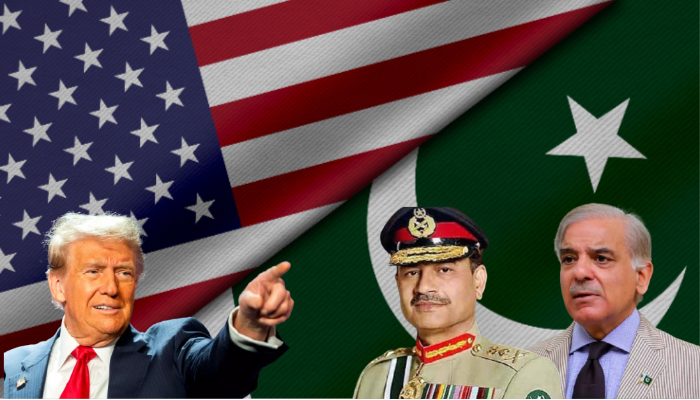
India firmly opposed Trump’s misleading claims, while Prime Minister Shehbaz Sharif thanked him for his alleged mediation efforts between the two nations. As if this were not enough, Pakistan also put forth the president’s name for the “Nobel Prize” for resolving disputes among rival nations and promoted his self-claimed reputation as a “global peacemaker” after Asim Munir, Chief of Army Staff of Pakistan and real power centre in the nation, went to White House for lunch at his invitation. Ironically, Munir took over the position after the country’s “stellar” performance during the military engagement with India.
Interestingly, Trump eventually accepted the truth and stopped crediting himself for the ceasefire before reiterating the lies yet again. However, the Modi government’s resolve to uphold its sovereign policy free from any external pressure and to clearly affirm its strong position on the global stage displeased him, whose ego was being stroked by Pakistan.
As a result, he became more accommodating towards the adversary of India while imposing high tariffs on it for “funding” the Ukraine war. Trump, who previously condemned Pakistan for protecting terrorists despite taking American dollars, developed newfound admiration which delighted its rulers, who intensified their sycophantic efforts akin to a needy dog doing tricks for its owner’s commendation or a treat.
Pakistan’s bonhomie with the US receives a slap of reality
Sharif and Munir presented Trump with a polished tray of “rare earth minerals” in September in an attempt to impress the White House and secure investment, as Bloch rebel groups issued a warning and activists denounced the display as a theatrical attempt to sell stolen wealth. Leaders of the Baloch community accused Pakistan of stealing their land, posing it as its own and trying to mortgage the region’s riches to the United States, just as it had with China.
A few months prior, the United States and Pakistan came to an accord whereby Washington declared to help Islamabad develop its purported oil reserves and even lower tariffs in July. “We are in the process of choosing the Oil Company that will lead this partnership. Who knows, maybe they’ll be selling oil to India some day,” he exclaimed.
The US then issued an Executive Order designating the Majeed Brigade and the Balochistan Liberation Army (BLA) as Specially Designated Global Terrorists (SDGTs). Baloch groups condemned the decision, voicing concerns that the region might become the next target for US oil exploitation. Nevertheless, Pakistan, infamous for putting a price on everything, including its sovereignty, people and land continued to be indifferent as its oppressive policies towards Balochistan remained unchanged.
The US embassy in Pakistan in December mentioned that the country would be delivering equipment valued at about $2 billion to mine precious metals in Balochistan and added that its Export-Import bank authorised $1.25 billion in funding for the Reko Diq mine in the region. The funding was termed as a “game changer” for American companies and local communities by Natalie Baker, Chargé d’Affaires of the US embassy.
Trump’s actions elated the terror state and were touted as proof of the profoundly intertwined bond between the two partners. However, there are no free lunches in the world, and American meals are exceptionally costly. Consequently, the US began to exert extreme pressure on its ally to deploy its troops to Gaza as part of a new stabilisation force, relegating it to its original function of a subordinate of the Western power.
The bully and its henchman
Pakistan is known to obey such orders, a fact that was also demonstrated in Afghanistan, where it commenced a campaign to oust the Soviet Union at the behest of the United States. Pakistani leaders even confessed to undertaking “dirty work” for Washington, representing the essence of their ties, which is that of a global bully and its henchman.
“We have been doing this dirty work for the United States for about 3 decades and the west, including Britain. That was a mistake and we suffered for that, and that is why you are saying this to me. If we had not joined the war against the Soviet Union and later on the war after 9/11, Pakistan’s track record was unimpeachable,” Defence Minister Khawaja Muhammad Asif exposed his nation when questioned about the country’s status as a breeding ground for terrorism during an interview with Sky News.
The US dominance over Pakistan was further illustrated by the statement of former Central Intelligence Agency (CIA) officer John Kiriakou, who candidly unveiled how Washington bought ex-president General Pervez Musharraf’s loyalty with massive financial support and even obtained control over the nation’s nuclear arsenal for a duration.
“When I was stationed in Pakistan in 2002, I was told unofficially that the Pentagon controlled its nuclear arsenal,” he told ANI. Kiriakou, who presided over the counterterrorism operations there, highlighted that Musharraf ceded authority fearing that nuclear weapons would end up in the hands of terrorists.
Notably, the late general also acknowledged how terrorists have been celebrated in his nation as heroes and are used to infiltrate neighbouring countries such as India and Afghanistan to inflict jihad.
Conclusion
Now, the latest directive that restricts Pakistani immigrants is only another example of the dysfunctional state’s genuine standing in the eyes of its foreign master. Furthermore, just as Pakistan cannot help but betray America despite receiving billions, the latter is unable to refrain from demeaning it even after engaging in performative camaraderie for the cameras.
However, the fact remains that Pakistan, which continually yearns for a few crumbs of US affection, has always been regarded as inferior, and the opinion has not altered under the Trump administration, as they are also aware of Pakistan’s true identity, which oscillates between being a thug for foreign entities and a pimp for its own.