A story of Hindu resilience and revival: How a unique Kumbh Mela, which was stopped following Islamic invasions, was brought to life in Bengal after 700 years
Bengal has historically been the cradle of Hindu thought and spirituality. Ancient Vedic traditions have merged with indigenous folk practices in this land of the Ganga-Brahmaputra delta to create a unique form of Hinduism. It is home to Tribeni (ত্রিবেণী), a town which is considered the southern counterpart of Prayagraj. Located in the Bansberia municipality of Hooghly district, Tribeni witnesses the confluence of 3 rivers – Ganga, Yamuna and Saraswati. This identification of Tribeni as ‘Daksina Prayag’ forms the theological foundation for the snanas and melas that have historically taken place in this town, especially during auspicious Kumbh Sankranti. The geography of Tribeni is intertwined with Saptagram, which is one of the most important religious and commercial centres. Vaishnavite scholar Brindaban Das describes Saptagram Tribeni Ghat as the place where the Saptarishi once performed penance and where bathing erased the sins of humanity. Large congregational baths (snas) at Prayagraj and other sacred confluences such as Tribeni in West Bengal have been taking place for centuries. It is believed that bathing in Tribeni awakens the latent power of the seeker, paves the way for gathering knowledge, and attaining peace. Kumbh Mela is held once every 4 years. While Ardha Kumbh is held every 6 years in Haridwar and Prayagraj, the Purna Kumbh is organised once every 12 years. Based on the position of Jupiter, Sun and the Moon, Purnakumbh is held in one of the four designated places – Prayagraj, Haridwar, Ujjain and Nashik. Maha Kumbh Mela is organised once every 144 years, the most recent being the one held in Prayagraj in 2024. Once upon a time, Kumbha Mela was prevalent in the sacred land of Bengal. The memory of the festival was erased following the repeated onslaught by Islamic invaders. 2025 Bongo Tribeni Kumbho Mohotosav Local historian Ashok Ganguly informed, “There was a connection between Tribeni Kumbh Mela and Gangasagar Mela. The saints of that time, after the end of Gangasagar Mela, used to come to Tribeni on foot. They used to take a bath on the day of Magh Sankranti. That day was considered Anukumbh in Tribeni. Saptagram and Tribeni were pilgrimage sites of education and culture”. Islamic tyrant Zafar Khan Ghazi laid siege to the town of Tribeni in 1292 CE and carried out a large-scale massacre of Hindus. A Vishnu temple, dating back to the Pala era, was destroyed. Gatherings and religious processions of Hindu devotees were stopped. The Tribeni Kumbh Mela came to a halt. Between 1288 CE and 1313 CE, Saptagram and Tribeni came firmly under the control of Islamic invaders. As per several historians, Hindu and Buddhist temples and monasteries were systemically destroyed, and mosques and dargahs were constructed atop earlier religious structures. 2025 Bongo Tribeni Kumbho Mohotosav Indian archaeologists Rakhaldas Banerji and Pranab Roy have found that architectural fragments at the Zafar Khan Gazi dargah pillars, sculptures include defaced Hindu, Jain, and Buddhist imagery. It is believed that the last Kumbh Mela in the region was organised only in 1319 CE. The wheels of destiny turned after 703 years. The Kumbh Mela, which had gone extinct, was revived again in 2022 CE by noted historian Kanchan Banerjee (lives in USA), Prabir Bhattacharya of Kolkata and the Tribheni Kumbho Parichalona Swamiti. With the guidance of saints and active support from local people, the Kumbh Mela and Kumbh Snan were organised on the occasion of Maghi Sankranti Bhaimi-Ekadashi. Monks and sages of Tribeni gathered at Saptrishi Ghat (where the 7 sages, namely Maitri, Atri, Pulasta, Pulah, Vyas, Vashishtha, and Vishwamitra practised penance). 2025 Bongo Tribeni Kumbho Mohotosav The event was named the ‘Bongo Tribeni Kumbho Mohotosav’. Since 2022, it has been held thrice at Tribeni through donor support and active contribution of the organisers and locals. PM Modi’s message on Kumbh Mela in Bengal Prime Minister Narendra Modi made a special mention of the Bongo Tribeni Kumbho Mohotosav during the 98th episode of his monthly radio programme ‘Mann Ki Baat,’ which was aired on 26th February 2023. He stated, “Mr Kanchan Banerjee, who lives in America, has attracted my attention to an initiative related to the preservation of our cultural heritage. The Tribeni Kumbho Mohotosav was organised this month in Bansberia town in Hooghly district of West Bengal. More than 8 lakh devotees have participated in this event.” “But do you know why it is so special? This tradition has been revived after 700 years. Although this tradition is thousands of years old, unfortunately, this Tribeni Mohotosav was stopped 700 years ago. It should have been started after independence, but that too could not be done. 2 years ago, this festival was restarted with the initiative of the local people and Tribheni Kumbho Parichalona Swamiti,” PM Modi emphasised. He further added,
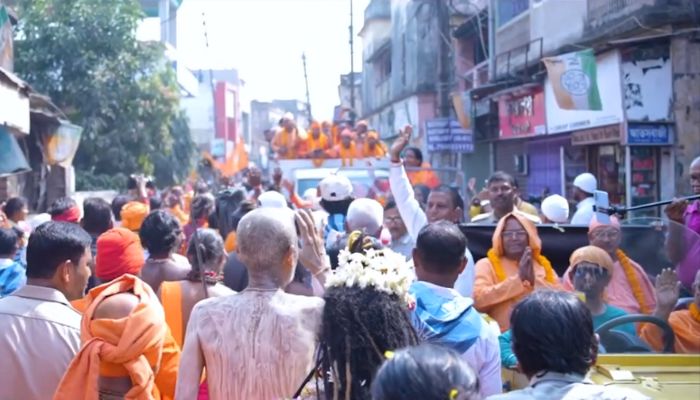

Bengal has historically been the cradle of Hindu thought and spirituality. Ancient Vedic traditions have merged with indigenous folk practices in this land of the Ganga-Brahmaputra delta to create a unique form of Hinduism. It is home to Tribeni (ত্রিবেণী), a town which is considered the southern counterpart of Prayagraj. Located in the Bansberia municipality of Hooghly district, Tribeni witnesses the confluence of 3 rivers – Ganga, Yamuna and Saraswati.
This identification of Tribeni as ‘Daksina Prayag’ forms the theological foundation for the snanas and melas that have historically taken place in this town, especially during auspicious Kumbh Sankranti. The geography of Tribeni is intertwined with Saptagram, which is one of the most important religious and commercial centres.
Vaishnavite scholar Brindaban Das describes Saptagram Tribeni Ghat as the place where the Saptarishi once performed penance and where bathing erased the sins of humanity. Large congregational baths (snas) at Prayagraj and other sacred confluences such as Tribeni in West Bengal have been taking place for centuries.
It is believed that bathing in Tribeni awakens the latent power of the seeker, paves the way for gathering knowledge, and attaining peace. Kumbh Mela is held once every 4 years.
While Ardha Kumbh is held every 6 years in Haridwar and Prayagraj, the Purna Kumbh is organised once every 12 years. Based on the position of Jupiter, Sun and the Moon, Purnakumbh is held in one of the four designated places – Prayagraj, Haridwar, Ujjain and Nashik. Maha Kumbh Mela is organised once every 144 years, the most recent being the one held in Prayagraj in 2024.
Once upon a time, Kumbha Mela was prevalent in the sacred land of Bengal. The memory of the festival was erased following the repeated onslaught by Islamic invaders.

Local historian Ashok Ganguly informed, “There was a connection between Tribeni Kumbh Mela and Gangasagar Mela. The saints of that time, after the end of Gangasagar Mela, used to come to Tribeni on foot. They used to take a bath on the day of Magh Sankranti. That day was considered Anukumbh in Tribeni. Saptagram and Tribeni were pilgrimage sites of education and culture”.
Islamic tyrant Zafar Khan Ghazi laid siege to the town of Tribeni in 1292 CE and carried out a large-scale massacre of Hindus. A Vishnu temple, dating back to the Pala era, was destroyed. Gatherings and religious processions of Hindu devotees were stopped. The Tribeni Kumbh Mela came to a halt.
Between 1288 CE and 1313 CE, Saptagram and Tribeni came firmly under the control of Islamic invaders. As per several historians, Hindu and Buddhist temples and monasteries were systemically destroyed, and mosques and dargahs were constructed atop earlier religious structures.

Indian archaeologists Rakhaldas Banerji and Pranab Roy have found that architectural fragments at the Zafar Khan Gazi dargah pillars, sculptures include defaced Hindu, Jain, and Buddhist imagery. It is believed that the last Kumbh Mela in the region was organised only in 1319 CE.
The wheels of destiny turned after 703 years. The Kumbh Mela, which had gone extinct, was revived again in 2022 CE by noted historian Kanchan Banerjee (lives in USA), Prabir Bhattacharya of Kolkata and the Tribheni Kumbho Parichalona Swamiti.
With the guidance of saints and active support from local people, the Kumbh Mela and Kumbh Snan were organised on the occasion of Maghi Sankranti Bhaimi-Ekadashi. Monks and sages of Tribeni gathered at Saptrishi Ghat (where the 7 sages, namely Maitri, Atri, Pulasta, Pulah, Vyas, Vashishtha, and Vishwamitra practised penance).

The event was named the ‘Bongo Tribeni Kumbho Mohotosav’. Since 2022, it has been held thrice at Tribeni through donor support and active contribution of the organisers and locals.
PM Modi’s message on Kumbh Mela in Bengal
Prime Minister Narendra Modi made a special mention of the Bongo Tribeni Kumbho Mohotosav during the 98th episode of his monthly radio programme ‘Mann Ki Baat,’ which was aired on 26th February 2023.
He stated, “Mr Kanchan Banerjee, who lives in America, has attracted my attention to an initiative related to the preservation of our cultural heritage. The Tribeni Kumbho Mohotosav was organised this month in Bansberia town in Hooghly district of West Bengal. More than 8 lakh devotees have participated in this event.”
“But do you know why it is so special? This tradition has been revived after 700 years. Although this tradition is thousands of years old, unfortunately, this Tribeni Mohotosav was stopped 700 years ago. It should have been started after independence, but that too could not be done. 2 years ago, this festival was restarted with the initiative of the local people and Tribheni Kumbho Parichalona Swamiti,” PM Modi emphasised.
He further added, “I congratulate all the people associated with this organisation. You are not only reviving a tradition, but you are also protecting the cultural heritage of India. Tribheni has been known as a sacred place in West Bengal for centuries. It is mentioned in various Mangal Kavyas, Vaishnav literature, Shakta literature and other Bengali literary works. It is known from various historical documents that this area was once the centre of Sanskrit education and Indian culture.”
“To restore the heritage of Tribheni and revive the pride of the Kumbha tradition, the Kumbha Mela was organised here last year. After 7 centuries, the three-day Kumbha Mahasana and Mela have generated a new energy in this area. For 3 days, people participated in the Ganga Aarti, Rudrabhishek and Yajna…Various rituals associated with Bengali traditions, such as Kirtan, Baul, Godiyo Nritto, Sree-Khol, Poter Gaan, Chou Nach were the centres of attraction in the evening program. It is a very commendable effort to connect our youth with the golden past of the country,” PM Modi concluded.
Ahead of the 3rd edition of the Bongo Tribeni Kumbho Mohotosav in February 2025, Prime Minister Narendra Modi wrote a letter to the organisers of the event, namely, the Bongiyo Hindu Dharma Prasar Somity (BHDPS) and Tribeni Kumbho Porichalona Somity (TKPS).

“Greetings and best wishes to the organisers for taking this thoughtful initiative. What enhances the significance of the occasion is that the Mohotosav was resumed in 2023 after several centuries by the local people. In doing so, people have not just revived our glorious ethos, but also transmitted this tradition to the younger generations,” PM Modi said in his letter.
He further added, “It is this aspect of divine cities such as Tribeni and Prayagraj that has been widely respected and admired for their auspiciousness. Dotted with bathing Ghats on the banks of Ganga, taking a dip at Tribeni is believed to be an extension of the tradition of Mahakumbh.”
PM Modi emphasised, “There are several historical references in Bangla literature that showcase this region as a thriving hub of education, art and architecture, culture and Sanskrit language. Such festive occasions are an opportunity to connect our youth with our socio-cultural traditions. The presence of saints and Punyarthis at the Kumbha Mahasankranti Maha Tribeni Sangam and Sant Julush (procession) will be truly an immersive experience for people of the Hooghly region and Bengal.”
Targeting of Bongo Tribeni Kumbho Mohotosav
In May 2023, propaganda outlet ‘Article 14’ carried out a hitjob on the Hindu festival, which has been revived after a period of 700 years. One Snigdhendu Bhattacharya published a malicious article to this effect titled, ‘Hindutva, A Tampered Research Paper & PM’s Endorsement Drive Effort To ‘Revive’ Kumbh Mela In Trinamool-Ruled West Bengal’

A similar hitpiece targeting the Bongo Tribeni Kumbho Mohotosav was published by The Hindu a month later on 9th June, 2023. It claimed that traditions were somehow being ‘invented’ in West Bengal as part of an alleged ‘political project.’

It is true that the formal term ‘Kumbh Mela’ appears relatively late in historical records. But the absence of terminology does not automatically imply the absence of Faith and practice. We must not forget that Indian history has endured long periods of invasions, during which documentation was often lost or interrupted.
Tribeni Kumbh Mela is not a modern invention or political project as claimed by propaganda outlets. It is a sacred landscape, sustained by geography, scripture, practice and collective memory. Its Sangam, its snas, and its melas firmly lie within the continuum of Hindu civilisational tradition.
The manufactured debate surrounding the Tribeni Kumbha history is very much part of the agenda to detach Hindus from the sense of belonging to their ‘little traditions’. We have seen how Hindu reawakening has been maliciously labelled as a ‘North Indian phenomenon’ with only one narrative. The new strategy now is to claim ‘lack of evidence’ of our past heritage.
The 2026 edition of Bengal Kumbh Mela
The 2026 Bongo Tribeni Kumbho Mohotosav is set to commence from 11th February and will conclude on 14th February. The 3-day event is expected to attract 14 to 16 lakh devotees.
Sadhus who had earlier participated in the Gangasagar Mela will grace the Kumbh Mela at Tribeni on the above-mentioned dates. According to historian Kanchan Banerjee, this year’s event will be more magnificent than last year’s.

The itinerary of the Bongo Tribeni Kumbho Mohotosav is as follows:
11th February 2026
- Suryodoy, Aditya Hriday Mantra & Shanti Bachan
- Nagar Sankirtan
- Yoga Asana (Club Ground)
- Rudrabhishek & Rudra Maha Joggo, Shiva Sahasra Naam (Club Ground)
- Bose Anko: Children’s Drawing Competition
- Dharma Sabha
- Ganga Aarti
12th February 2026
- Shakti Kumbh Procession and Photo Exhibition
- Address by the Governor of West Bengal
- Gita Path
- Sadhu Bhandara
- Kali Kirtan
- Godiyo Nritto
- Ganga Aarti
13th February 2026
- Amrita Snan Yatra
- Dharma Sabha
- Sadhu Bhojan
- Dhormiyo Onusthan / Kirtan (Club Ground)
- Ganga Aarti (Saptarshi ghat)

Fundraiser and Sponsorships
OpIndia spoke to Pallab Mondal, a researcher and columnist who is working as the coordinator of the Bongo Tribeni Kumbho Mohotosav.
He informed us about the budget constraints and challenges involved in the organisation of the event, which is estimated to witness the footfall of millions of devotees. Mondal added that bhandara and prasadam are available to everyone who participates in the event. He appealed to Hindus to contribute to the noble cause.
Here are the bank account details:
Bangiya Sanatani Sanskriti Parishad
Canara Bank, Salt Lake City Branch
Account no. 110199375104
IFSC: CNRB0002549
For sponsorships and collaborations, companies can reach out to event coordinator Pallab Mondal at +91 7001243943 and make the 2026 edition of ‘Bongo Tribeni Kumbho Mohotosav’ a grand success.