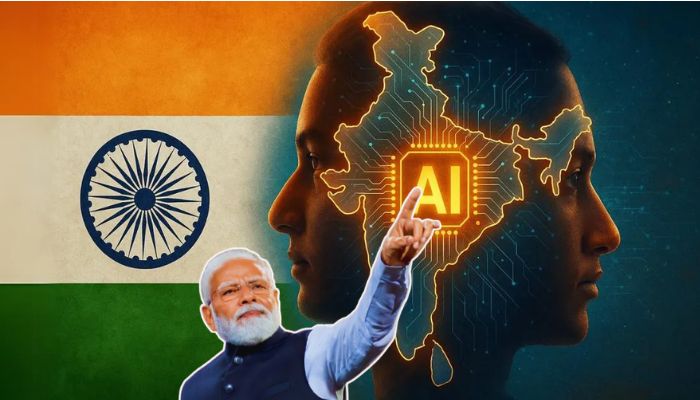
AI Impact Summit, semiconductors, Bhashini and more: Read how the Modi govt is making giant strides in technological advancements and preparing India for the future
Over the past decade, India has witnessed significant digital and technological transformation. To make India future-ready, the Modi government has given a massive push in the technology sector through various initiatives and decisions that will have long-term impacts. To actualise the vision of a Viksit Bharat (Developed India) by 2047, the Modi government has rolled out various initiatives, rooted in the resolve of Atmanirbhar Bharat, that will potentially propel India to the position of a global tech leader. This push is not confined to mere rhetoric or papers but reflects in the opening of avenues that will create jobs, boost productivity, and ensure that India is ready for the future digital age. The key metrics include a booming startup ecosystem, massive PLI-fuelled manufacturing growth, and the building of sovereign tech capabilities. India’s stride in Artificial Intelligence: From follower to frontrunner The Modi government has taken the imperative to bolster India’s AI ecosystem seriously, making AI a national priority, aiming for a sovereign AI tailored to India’s requirements. In 2024, a flagship program, India AI Mission, was launched. Approved with Rs 10,372 crore over five years, the program has seven pillars: compute capacity, innovation centres, datasets, applications, skills, startup funding, and safe/trusted AI. Since its launch in March 2024, the mission has made significant progress in expanding India’s computing infrastructure. From an initial target of 10,000 Graphics Processing Units (GPUs), India has now achieved over 38,000 GPUs, reflecting India’s progress in providing affordable access to world-class AI resources. The first pillar, IndiaAI Compute Pillar, provides high-end GPUs at affordable costs. By December 2025, over 38,000 GPUs at a subsidized rate of Rs 65 per hour. The second pillar, IndiaAI Application Development Initiative, was launched in August 2024, to tackle India’s specific challenges, particularly in the healthcare, agriculture, climate change, governance, and assistive learning technologies sectors. As per the IADI’s website, the initiative sources problem statements from Central Ministries, State Departments, and institutions in critical sectors and invites AI researchers, innovators and start-ups to build, develop and deploy solutions that address the identified challenges. Meanwhile, AIKosh (Dataset Platform), develops large datasets for training AI models by integrating data from government and non-government sources. This dataset platform has more than 9,867 datasets and 273 AI models across 20 sectors. Under the IndiaAI FutureSkills program, AI-skilled professionals are being trained. With this program, the Central government intends to create a robust pipeline of AI-skilled professionals through strategic interventions at various educational levels, from undergraduate to doctoral studies. The initiative provides support to 500 PhD fellows, 5,000 postgraduates, and 8,000 undergraduates for talent development. Besides training AI-skilled professionals, the Modi government has also focused on providing necessary funding for native AI startups under the program, IndiaAI Startup Financing. Launched in March 2025, this initiative helps 10 Indian startups expand into the European market in collaboration with Station F and HEC Paris. Meanwhile, the AI Foundation Models pillar backs the development of indigenous foundational models, including large language and multimodal models, aligned with India’s linguistic, cultural and socio-economic diversity. On 13th February, Union Minister of State for Electronics and Information Technology, Jitin Prasada, informed the Rajya Sabha that twelve organisations and consortia, including Sarvam AI, Soket AI, Gnani AI, Gan AI, Avataar AI, IIT Bombay Consortium (BharatGen), GenLoop, Zenteq, Intellihealth, Shodh AI, Fractal Analytics Ltd., and Tech Mahindra Maker’s Lab, have been shortlisted to develop indigenous foundational models. Recently, Bengaluru-based Sarvam AI outperformed giant AI models like Gemini and ChatGPT on certain benchmarks in optical character recognition (OCR). The Safe and Trusted AI pillar is aimed at designing and developing adequate guardrails to advance the responsible development, deployment, and adoption of AI. The idea is to implement responsible AI projects that promote the development of indigenous tools and frameworks, self-assessment checklists for innovators, and other guidelines and governance frameworks that advance the adoption of responsible AI principles throughout the AI lifecycle. “They focus on machine unlearning, bias mitigation, privacy-preserving ML, explainability, auditing, and governance testing. Over 400 applications were received in the second round. An expression of interest was published on 9 May 2025 for partner institutions to join the IndiaAI Safety Institute,” the government says. Breaking language barriers with Bhashini A

Over the past decade, India has witnessed significant digital and technological transformation. To make India future-ready, the Modi government has given a massive push in the technology sector through various initiatives and decisions that will have long-term impacts. To actualise the vision of a Viksit Bharat (Developed India) by 2047, the Modi government has rolled out various initiatives, rooted in the resolve of Atmanirbhar Bharat, that will potentially propel India to the position of a global tech leader.
This push is not confined to mere rhetoric or papers but reflects in the opening of avenues that will create jobs, boost productivity, and ensure that India is ready for the future digital age. The key metrics include a booming startup ecosystem, massive PLI-fuelled manufacturing growth, and the building of sovereign tech capabilities.
India’s stride in Artificial Intelligence: From follower to frontrunner
The Modi government has taken the imperative to bolster India’s AI ecosystem seriously, making AI a national priority, aiming for a sovereign AI tailored to India’s requirements.
In 2024, a flagship program, India AI Mission, was launched. Approved with Rs 10,372 crore over five years, the program has seven pillars: compute capacity, innovation centres, datasets, applications, skills, startup funding, and safe/trusted AI. Since its launch in March 2024, the mission has made significant progress in expanding India’s computing infrastructure. From an initial target of 10,000 Graphics Processing Units (GPUs), India has now achieved over 38,000 GPUs, reflecting India’s progress in providing affordable access to world-class AI resources.
The first pillar, IndiaAI Compute Pillar, provides high-end GPUs at affordable costs. By December 2025, over 38,000 GPUs at a subsidized rate of Rs 65 per hour.
The second pillar, IndiaAI Application Development Initiative, was launched in August 2024, to tackle India’s specific challenges, particularly in the healthcare, agriculture, climate change, governance, and assistive learning technologies sectors. As per the IADI’s website, the initiative sources problem statements from Central Ministries, State Departments, and institutions in critical sectors and invites AI researchers, innovators and start-ups to build, develop and deploy solutions that address the identified challenges.
Meanwhile, AIKosh (Dataset Platform), develops large datasets for training AI models by integrating data from government and non-government sources. This dataset platform has more than 9,867 datasets and 273 AI models across 20 sectors.
Under the IndiaAI FutureSkills program, AI-skilled professionals are being trained. With this program, the Central government intends to create a robust pipeline of AI-skilled professionals through strategic interventions at various educational levels, from undergraduate to doctoral studies. The initiative provides support to 500 PhD fellows, 5,000 postgraduates, and 8,000 undergraduates for talent development.
Besides training AI-skilled professionals, the Modi government has also focused on providing necessary funding for native AI startups under the program, IndiaAI Startup Financing. Launched in March 2025, this initiative helps 10 Indian startups expand into the European market in collaboration with Station F and HEC Paris.
Meanwhile, the AI Foundation Models pillar backs the development of indigenous foundational models, including large language and multimodal models, aligned with India’s linguistic, cultural and socio-economic diversity.

On 13th February, Union Minister of State for Electronics and Information Technology, Jitin Prasada, informed the Rajya Sabha that twelve organisations and consortia, including Sarvam AI, Soket AI, Gnani AI, Gan AI, Avataar AI, IIT Bombay Consortium (BharatGen), GenLoop, Zenteq, Intellihealth, Shodh AI, Fractal Analytics Ltd., and Tech Mahindra Maker’s Lab, have been shortlisted to develop indigenous foundational models.
Recently, Bengaluru-based Sarvam AI outperformed giant AI models like Gemini and ChatGPT on certain benchmarks in optical character recognition (OCR).
The Safe and Trusted AI pillar is aimed at designing and developing adequate guardrails to advance the responsible development, deployment, and adoption of AI. The idea is to implement responsible AI projects that promote the development of indigenous tools and frameworks, self-assessment checklists for innovators, and other guidelines and governance frameworks that advance the adoption of responsible AI principles throughout the AI lifecycle.
“They focus on machine unlearning, bias mitigation, privacy-preserving ML, explainability, auditing, and governance testing. Over 400 applications were received in the second round. An expression of interest was published on 9 May 2025 for partner institutions to join the IndiaAI Safety Institute,” the government says.
Breaking language barriers with Bhashini
Aimed at breaking language barriers by providing translation and speech tools in multiple Indian languages in real-time, the Modi government launched an AI-powered program called Bhashini in 2023. The program powers multilingual government services apps, and content with billions of inferences processed.
Pertinently, Bhashini has migrated to the sovereign Indian cloud for data security. Bhashini has integrated into panchayats and welfare schemes for real digital inclusion as envisioned by the Modi government.
In addition to Bhashini, the Centre also launched a multilingual AI model, BharatGen AI, in June 2025. This government-funded and built using domestic datasets multimodal large language model supports 22 Indian languages, integrating text, speech, and image understanding.
Kisan e-Mitra: AI for farmers
Launched in 2023 and upgraded in 2024, Kisan e-Mitra is an AI chatbot on the PM-KISAN portal, resolving grievances in more than 11 languages. Kisan e-Mitra handles millions of queries under 49 categories, with Bhashini’s IndicTrans2 model. In November 2025, it was reported that Kisan e-Mitra handled over 2.69 million queries in 186 days, marking not only a sharp increase from the traditional grievance redressal mechanism but also a surge in effective resolution, empowering over 2,90,000 farmers.
AI Impact Summit 2026
Starting on 16th February 2026, India is hosting the India AI Impact Summit to showcase India’s AI capabilities and encourage innovation across sectors. This is the first major AI summit in the Global South, drawing more than 20 global leaders, tech CEOs like Sam Altman and Sundar Pichai. The Summit focuses on ethical, human-centric and inclusive AI.
Indigenous semiconductors: A gradual but decisive pivot from import dependence to self-reliance
It is said that chips are the cornerstone of tech self-reliance. The Modi government has, through its policy interventions, demonstrated that it understands that India needs to become more and more self-reliant in the semiconductor arena.
India is rapidly expanding and bolstering its semiconductor chip design ecosystem. The Modi government launched the India Semiconductor Mission
In 2021, with Rs 76,000 crore in incentives. The Mission approved at least 10 projects worth Rs 1.6 lakh crore across six states. The initiative is aimed at attracting global manufacturers, building fabs, packaging units and a local supply chain to reduce reliance on imports. The initial focus is on mature-node fabs (28nm to 65nm), not bleeding-edge nodes like 5nm or 3nm, which are dominated by TSMC and Samsung.
In May 2025, the Union Cabinet approved India’s sixth semiconductor manufacturing unit in Jewar in western Uttar Pradesh, for establishment through a joint venture between the HCL Group and Taiwanese electronics giant Foxconn. Among the five semiconductor plants, four are in Gujarat: Tata Electronics-PSMC Semiconductor fab, CG Power-Renesas-Stars Microelectronics ATMP unit, Micron Technology’s ATMP unit, and Kaynes Semicon ATMP unit, while the Tata Semiconductor Assembly and Test (TSAT) Unit is in Assam. With these, India is pushing for “Made in India” chips for space, defence and EVs to reduce reliance on Taiwan and create local high-skill jobs.
To support indigenous startups, the Modi government launched the Design Linked Incentive (DLI) Scheme in 2022, to ensure venture capital investment in this sector by curbing upfront risk through financial support, access to advanced EDA tools, IP cores etc. and greater ecosystem awareness of semiconductor chip design.
In November 2024, the Centre approved C2i Semiconductors for financial support and access to advanced chip design tools under the DLI Scheme. Led by Semicon industry veterans, C2i Semiconductors is developing power-management semiconductor solutions for next-generation AI data centres and cloud infrastructure. As per a government press release dated 16th February 2026, C2i has “become one of the top three users amongst 100 companies of the centralised Electronic Data Automation (EDA) tools, provided through the centralised EDA tool grid at the ChipIN Centre under the DLI Scheme.”
In the Union Budget 2026-27, the Modi government announced the India Semiconductor Mission 2.0 with Rs 1,000 crore allocated to bolster domestic semiconductor capabilities. In its new phase, the Mission will focus on the production of semiconductor equipment and materials in India. Special focus will be on designing full-stack Indian semiconductor intellectual property and fortifying both domestic and global supply chains.
Data Centres: Transforming India into a global digital hub
To boost AI and cloud growth, the Modi government is aggressively building data infrastructure. In the Union Budget 2026-27, the Centre announced a long-term tax holiday framework designed to attract foreign investment while preserving India’s domestic tax base.
As reported earlier, foreign companies that procure data centre services from specified data centres located in India will be exempt from paying tax in India on income earned from serving customers outside the country until 31st March 2047. To ensure that the tax holiday does not mean Indian interests are overlooked, the Modi government added a caveat that revenue earned from Indian users must be routed through an Indian reseller entity and taxed domestically.
Under the Modi government, India is attracting massive foreign funding in this arena. In December 2025, Microsoft CEO Satya Nadella announced a US$17.5 billion investment to expand India’s AI infrastructure, develop advanced skills, and strengthen sovereign technological capabilities.
In October 2025, Google announced its plans to develop India’s largest AI data centre campus in Andhra Pradesh with an investment of $15 billion over five years.
With various PLI schemes to support telecom, electronics and other sectors, National Quantum Mission for qubits and secure comms, IN-SPACe opening doors for private players in space and defence tech, and expansion of UPI, alongside various innovation and skills related schemes rolled out, the Modi government is truly living up to PM Modi’s emphasis that this is India’s “Techade” or a decade, where technology drives growth.