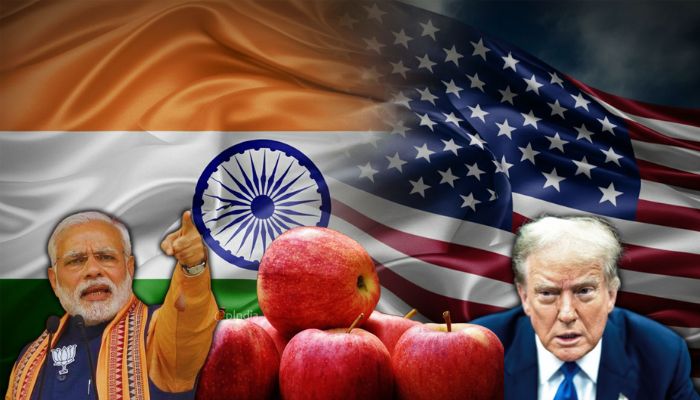
Apples, alarmism and half-truths: How media coverage is warping public perception of the India–US Trade Deal
Ever since India and the United States announced a framework for an interim trade deal, common people are curious about what the final agreement will look like, politicians are either fully endorsing it or trashing it, and traders are seeing the impending agreement with cautious optimism. As part of the India-US agreement, India has agreed to grant the US quota-based concessions on specific agricultural products, including apples. However, the prospect of American apples entering Indian markets has alarmed Indian growers, particularly in Jammu and Kashmir, Himachal Pradesh, and Uttarakhand. The quota allocation for US apples, concerns of Indian growers and the Central government’s assurance Under the India-US trade agreement, the Indian government has reduced import duty on US apples from 50% to 25%, coupled with a Minimum Import Price (MIP) of Rs 75 to 80 per kg. This move effectively prevents very cheap apples from flooding Indian markets and harming the business of local growers, as the landed cost would be around Rs 100 per kg or more after duty. However, despite the quota-based system providing protection, apple growers in Jammu and Kashmir, particularly the Kashmir Valley, Himachal Pradesh, and Uttarakhand, have raised an alarm. They fear that even limited imports of American apples, which are deemed uniform, high-quality and competitively priced, could depress prices, especially for stored domestic apples sold off-season. Notably, Kashmir accounts for around 70 to 80% of Indian apple production, thus making the fruit immensely significant for local employment and stability. In Jammu and Kashmir, the apple economy is estimated to be worth Rs 12,000 crore, providing livelihood and direct and indirect employment to around 3.5 million people. In the 2024-25 season, around 21 lakh tonnes of Kashmiri apples were sold across Delhi, Bengaluru, Chennai, Ahmedabad, Kolkata, and Mumbai, etc. Besides Jammu and Kashmir, a section of farmers in Himachal Pradesh and Uttarakhand are also linking the entry of US apples in India to their survival. They argue that surging input costs, climate-related losses, limited cold storage facilities, and transport disruptions have already affected margins for local growers. They fear that the influx of American apples during the peak season would depress prices and disrupt local economies. The Kashmir Valley Fruit Growers Cum Dealers Union has written a letter to Prime Minister Narendra Modi, demanding an import duty of over 100% on apples from the US and Europe. The traders and orchardists cautioned that a liberal import of foreign apples would turn India’s horticulture sector into a “sick industry”. In Himachal Pradesh as well, concerns have been raised that domestic premium apples sell between Rs 100 and Rs 150 per kg, and if US apples are available at similar prices, people will opt for the imported apples. While some opine that the MIP on American apples should have been Rs 100 per kg, many other growers are of the view that the India-US trade deal will have very little effect on the domestic apple economy. They believe that the local premium apples are good enough to compete with imports, and that instead of urging the government to raise MIP on American apples, local growers should seek subsidies and better planting material. Amidst all this, Union Commerce Minister Piyush Goyal has given repeated assurances that the domestic growers are “fully protected”. Not only in the context of apple growers, but the Minister has also maintained that now or ever in future, India also will not enter into any trade agreement with a foreign country that breaches its redlines in the agriculture and dairy sector. The commerce minister said that the interests of Indian farmers and MSMEs are fully protected. On the specific American apples import issue, the minister said that domestic production of apples is not in surplus against the demand. Domestic production stood roughly at 20-21 lakh tonnes, while the demand is more than 25-26 lakh tonnes. India already imports around 5.5 lakh tonnes of apples annually, with the US being the major supplier. Minister Goyal explained that the eventual price of imported American apples would be around Rs 100, and thus, the local growers and traders should not fear loss of profits. “We are not surplus in apples. The demand for apples is more than 25-26 lakh tons. We produce about 20-21 lakh tons. As we speak, we import 5.5 lakh tons of apples every year. And a large quantity of that comes from the United States of America. We have not opened up apples. We have given them a quota on apples, which we will procure from there. That is less than the Current imports of apples from the USA,” he said. “We have been very cautious in our opening up. Today, Apple has a minimum import price of Rs 50. And there’s a 50 per cent duty which adds Rs 25. So, Rs 75 is the base, or the floor, below which goods don’t enter the country. So in

Ever since India and the United States announced a framework for an interim trade deal, common people are curious about what the final agreement will look like, politicians are either fully endorsing it or trashing it, and traders are seeing the impending agreement with cautious optimism. As part of the India-US agreement, India has agreed to grant the US quota-based concessions on specific agricultural products, including apples. However, the prospect of American apples entering Indian markets has alarmed Indian growers, particularly in Jammu and Kashmir, Himachal Pradesh, and Uttarakhand.
The quota allocation for US apples, concerns of Indian growers and the Central government’s assurance
Under the India-US trade agreement, the Indian government has reduced import duty on US apples from 50% to 25%, coupled with a Minimum Import Price (MIP) of Rs 75 to 80 per kg. This move effectively prevents very cheap apples from flooding Indian markets and harming the business of local growers, as the landed cost would be around Rs 100 per kg or more after duty.
However, despite the quota-based system providing protection, apple growers in Jammu and Kashmir, particularly the Kashmir Valley, Himachal Pradesh, and Uttarakhand, have raised an alarm. They fear that even limited imports of American apples, which are deemed uniform, high-quality and competitively priced, could depress prices, especially for stored domestic apples sold off-season.
Notably, Kashmir accounts for around 70 to 80% of Indian apple production, thus making the fruit immensely significant for local employment and stability. In Jammu and Kashmir, the apple economy is estimated to be worth Rs 12,000 crore, providing livelihood and direct and indirect employment to around 3.5 million people. In the 2024-25 season, around 21 lakh tonnes of Kashmiri apples were sold across Delhi, Bengaluru, Chennai, Ahmedabad, Kolkata, and Mumbai, etc.
Besides Jammu and Kashmir, a section of farmers in Himachal Pradesh and Uttarakhand are also linking the entry of US apples in India to their survival. They argue that surging input costs, climate-related losses, limited cold storage facilities, and transport disruptions have already affected margins for local growers. They fear that the influx of American apples during the peak season would depress prices and disrupt local economies.
The Kashmir Valley Fruit Growers Cum Dealers Union has written a letter to Prime Minister Narendra Modi, demanding an import duty of over 100% on apples from the US and Europe. The traders and orchardists cautioned that a liberal import of foreign apples would turn India’s horticulture sector into a “sick industry”.
In Himachal Pradesh as well, concerns have been raised that domestic premium apples sell between Rs 100 and Rs 150 per kg, and if US apples are available at similar prices, people will opt for the imported apples. While some opine that the MIP on American apples should have been Rs 100 per kg, many other growers are of the view that the India-US trade deal will have very little effect on the domestic apple economy. They believe that the local premium apples are good enough to compete with imports, and that instead of urging the government to raise MIP on American apples, local growers should seek subsidies and better planting material.
Amidst all this, Union Commerce Minister Piyush Goyal has given repeated assurances that the domestic growers are “fully protected”. Not only in the context of apple growers, but the Minister has also maintained that now or ever in future, India also will not enter into any trade agreement with a foreign country that breaches its redlines in the agriculture and dairy sector.
The commerce minister said that the interests of Indian farmers and MSMEs are fully protected. On the specific American apples import issue, the minister said that domestic production of apples is not in surplus against the demand. Domestic production stood roughly at 20-21 lakh tonnes, while the demand is more than 25-26 lakh tonnes. India already imports around 5.5 lakh tonnes of apples annually, with the US being the major supplier. Minister Goyal explained that the eventual price of imported American apples would be around Rs 100, and thus, the local growers and traders should not fear loss of profits.
“We are not surplus in apples. The demand for apples is more than 25-26 lakh tons. We produce about 20-21 lakh tons. As we speak, we import 5.5 lakh tons of apples every year. And a large quantity of that comes from the United States of America. We have not opened up apples. We have given them a quota on apples, which we will procure from there. That is less than the Current imports of apples from the USA,” he said.
“We have been very cautious in our opening up. Today, Apple has a minimum import price of Rs 50. And there’s a 50 per cent duty which adds Rs 25. So, Rs 75 is the base, or the floor, below which goods don’t enter the country. So in some sense, that’s the protection that the apple farmers also get, that nobody can dump material and make it so cheap that apples don’t get a fair value. Even in the quota we have given to the US, the minimum import price is Rs 80. They make high-quality apples. It’s Rs 80. There’s a Rs 20 duty on that. So, the landed price of that will be 100 rupees,” the minister said.
Further asserting that the local apple industry will not be hurt by the regulated entry of US apples, Piyush Goyal said, “It’s not in competition with our farmers. Not hurting the apple industry over here. And again, limited to a quota that is less than what they are exporting to India even today. And certainly, only a portion of the 5.5 lakh tons of apples that we are importing into India. Tell me which farmer in any hill state is hurt by this. Let any farmer explain to me what is the hurt in this.”
The prism of victimhood: Indians must escape the spiral of outrage over every progressive step
Despite the Modi government ensuring a calibrated concession for American apples and not a full market opening, local stakeholders are indulging in and also falling for the fearmongering. However, the issue transcends apples. There is evidently a deep-seated tendency in Indian policy and public discourse to frame exposure to global competition, even when it is in a controlled fashion, as victimisation rather than a catalyst for self-improvement. There is a serious need to pivot from the existing “they are harming us” mindset to “how do we make things better to meet this?”
India has a robust economy and a massive market that every major country wants enter. India aspires to become a developed nation and is relentlessly pursuing this aspiration. Such a purpose-driven country cannot have its business and traders continue using protectionism as a convenient shield. Retaliatory duties, high tariffs, and non-tariff barriers, etc, allowed local producers to avoid hard reforms. In fact, the 2020 farmers’ protest showed that reforms, no matter how good and how well-intentioned they are, are not easily accepted and even get rejected.
Coming back to the US apples issue, Indian apples, despite being flavourful, are inconsistent in quality. Issues like inadequate grading and packaging, weak cold-chain infrastructure, and reluctant adoption of modern orchard management get blamed on ‘external factors’ rather than their own shortcomings. American apples get an edge over Indian apples due to quality, which is backed by the use of advanced technology, better pest management, controlled atmosphere storage ensuring longer shelf life, and adherence to quality standards.
The excuses of ‘sanctions’ and ‘unfair foreign competition’ have already caused delay in investments that competitive markets, be it New Zealand or Chile or the US, made decades ago. If Chilean, Turkish and the previous imports of foreign apples did not wipe out Himachali or Kashmiri apple growers, the sudden hue and cry over US apples does not make much sense.
The fact is that local apples carry cultural appeal, a lower base price, and domestic traders have established supply chains, giving Indian stakeholders an edge over foreign competition. The real differentiator in this scenario would be consumer preference; if US apples gain dramatically high preference, then there will be a noticeable quality or value gap which domestic producers will have to match.
Higher quality, diverse options and competitive prices create value and generate pressure for improvement. It is high time that instead of outraging, protesting and playing victim, domestic producers and traders level up their game, focus on improving quality, going for better branding, and investing in better infrastructure like cold-storage, etc, instead of pressuring the government to shut doors to foreign trading partners. In fact, the domestic stakeholders should seek the government’s help in filling in the quality, technology and infrastructure gaps.
There may be immediate disruptions; however, competition does not devastate capable producers; rather, it weeds out inefficiency and rewards adaptation. The post-1991 liberalisation trajectory of India’s auto, telecom, and consumer goods sectors serves as a fitting example of this. Domestic producers may try to bend the government into giving the desired reprieve; however, it is the consumers who are deprived of diverse and perhaps better options and paying higher prices. Thus, the culture of fostering complacency must be ditched.
Clinging to the idea of monopoly and victimhood at the same time limits the potential of Indian producers. They need to reckon with realities, upgrade practices, enhance post-harvest handling, and become competitive against global standards. Competition is essentially a market mechanism that triggers the raising of standards, not victimisation. This victimhood mindset only keeps producers and the nation weaker in the long run. Understandably, all this is better said than done; however, Indian producers and traders have to choose between stagnation disguised as ‘protection’ and dynamic growth by facing competition.
It is also the responsibility of the state/UT administration as well as the Central government to address the genuine concerns raised by the domestic producers and traders, and provide all necessary transition support to ensure that their interests are not crushed between foreign competition, consumer preferences and existing climatic, infrastructure or high production cost-related challenges.
Mainstream media amplifying the Kashmiri apple grower’s victimhood narrative
However, outrage over every progressive step merely because it may cause immediate discomfort is not good for the country. Every trade deal creates winners and losers. A mature economy like India must absorb the short-term disruptions with confidence, with its people showing the resilience to adapt, upgrade skills, and meet global competitive standards instead of lamenting the loss of a protected advantage.
The mainstream Indian media should also instead of plainly amplifying Kashmiri apple growers’ victimhood narrative; framing the limited and safeguarded import of US apples as some sort of existential threat. Instead of reinforcing a victimhood prism and lending credence to the opposition’s ‘total surrender’ rubbish, the media should have highlighted how India already imports apples year-round from various countries without crushing domestic production. Amidst the whole alarmist and victimhood noise amplified by the media, the fact that American apples will be competing mainly in the premium-urban segments, and not wipe out local ones, is getting suppressed.