India’s highways go green: NHAI launches Bee Corridors to support pollinators and boost rural economy
The National Highways Authority of India (NHAI) announced plans to establish specialised ‘Bee Corridors’ along the nation’s vascular system, its extensive highway network, marking a revolutionary step towards sustainable infrastructure. This project, unveiled on February 17, 2026, represents a shift from conventional decorative roadside planting to an ecological focus on plants that benefit pollinators like bees. In order to combat diminishing bee numbers and improve biodiversity, NHAI plans to plant millions of bee-friendly trees and plants. This is a continuation of Prime Minister Narendra Modi’s long-standing push to promote beekeeping as a component of India’s ‘Sweet Revolution.’ The blueprint The plan is to plant 40 lakh trees in fiscal year 2026-2027, with an astounding 60% of those trees dedicated to the Bee Corridor project, according to the Ministry of Road Transport and Highways (MoRTH). Clusters of flowering trees will be strategically planted by the NHAI at intervals of 500 to 1 kilometre. The average habitat range of honeybees is used to determine this precise distance, which guarantees that they have stepping stones of nutrition as they go along their habitat. Neem, Karanj, Mahua, Palash (Flame of the Forest), Bottle Brush, Jamun, Siris, and other local, nectar-rich species are the ones in focus. Seasonal starvation, in which flowers only blossom in the spring, is a serious problem in many artificial landscapes. A variety of plants that flower at different times are guaranteed by the NHAI plan, ensuring a year-round supply of pollen and nectar. The sweet revolution connection We must examine the policy ecosystem from which this move originates in order to comprehend its significance. This endeavour is the infrastructural realisation of a vision that was launched nearly a decade ago. Speaking at a rally in Banaskantha, Gujarat, in 2016, Prime Minister Narendra Modi urged farmers to pursue apiculture, or beekeeping, in addition to agriculture, calling for a Sweet Revolution (Mithi Kranti). He famously said that a sweet revolution may change the rural economy in the same way that the white revolution changed the dairy industry. The Khadi and Village Industries Commission (KVIC) launched the Honey Mission (2017), which to date has distributed 2,00,000 bee boxes to farmers and created jobs for tribals and unemployed youth. In 2020, the government announced the National Beekeeping and Honey Mission, which aims to increase honey production, train producers, and connect them to markets. The outcomes have been spectacular. Honey output in India has increased from 70-75 thousand metric tonnes per year a decade ago to roughly 1.25 lakh metric tonnes by 2025, a 60% rise. This expansion propelled India to the world’s top honey producers and exporters, with efforts such as the Honey Mission training thousands of farmers and promoting rural livelihoods. However, one key bottleneck remained, which is habitat loss. You can give a farmer a bee box, but you can’t force bees to make honey if there are no flowers around. Rapid urbanisation and monoculture farming (growing only one crop) have resulted in green deserts where bees suffer. The NHAI’s Bee Corridors fill this need. By converting thousands of km of roadway land into flowering zones, the government is effectively creating the feeding habitat needed to support the Sweet Revolution. Environmental imperatives: Safeguarding biodiversity through bee corridors Bees are keystone species in ecosystems and do more than solely produce honey. Bees and other insects pollinate 87 major food crops and 35% of the world’s agricultural area. Deteriorating bee numbers as a result of habitat fragmentation, pesticides, and climate change represent a serious concern in India, where more than half of the population works in agriculture. By establishing interconnected habitats that permit pollinators to travel freely, bee corridors combat this and lessen genetic bottlenecks and isolation. By drawing birds, butterflies, and other species, they promote biodiversity and healthier ecosystems. Environmentally, these corridors lessen the effects of climate change. Bees contribute to the preservation of plant diversity, which stabilises soils and sequesters carbon. Furthermore, roadside plants in corridors can minimise pollution by filtering air and controlling precipitation, while also protecting from vehicle turbulence and pollutants. Such programs provide vital adaptation techniques in a warming world where bees’ viable ranges are decreasing, guaranteeing pollination services that support environmental stability and food security. The economic multiplier: Boosting growth and livelihoods Bee corridors have significant economic repercussions. In India, pollinators play an equally important role in agriculture as they do in the United States, where their annual contribution to the economy is estimated at $34 billion. For fruits, vegetabl
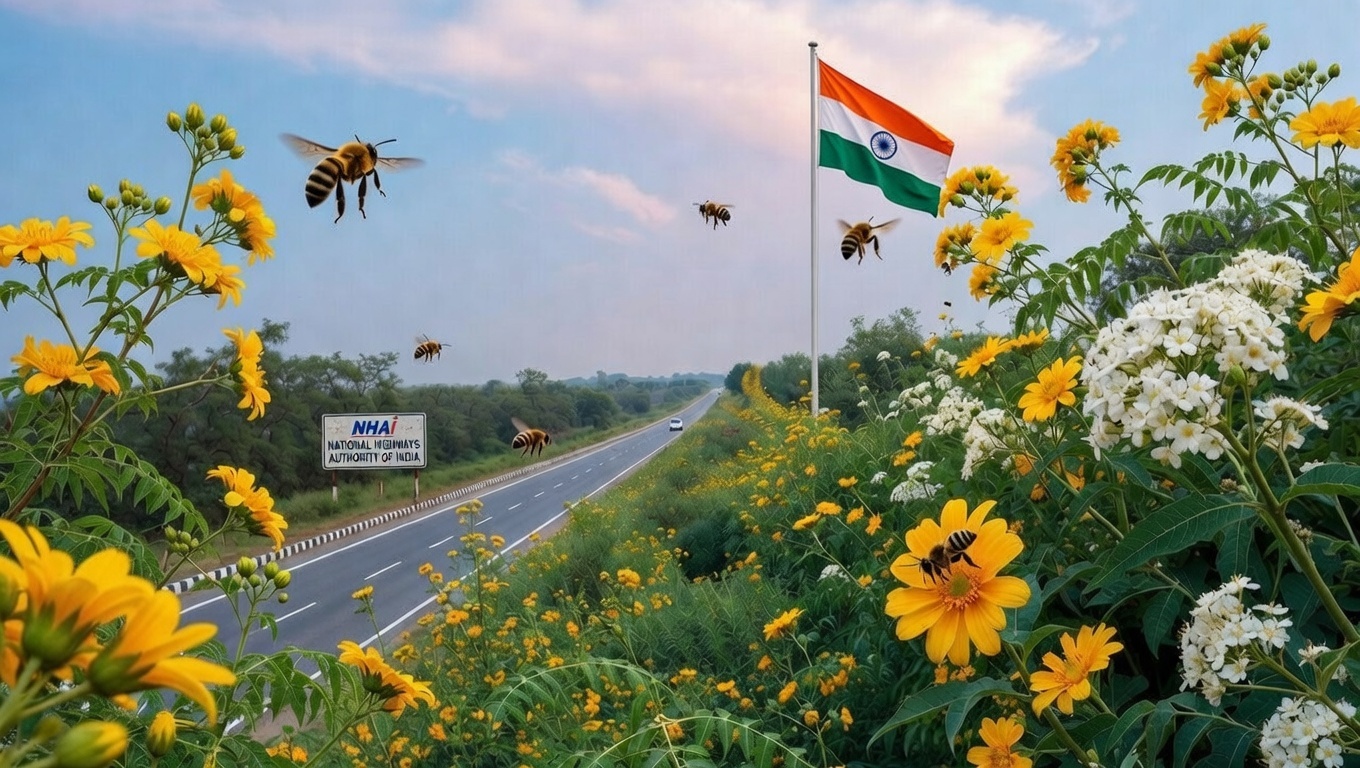

The National Highways Authority of India (NHAI) announced plans to establish specialised ‘Bee Corridors’ along the nation’s vascular system, its extensive highway network, marking a revolutionary step towards sustainable infrastructure. This project, unveiled on February 17, 2026, represents a shift from conventional decorative roadside planting to an ecological focus on plants that benefit pollinators like bees.
In order to combat diminishing bee numbers and improve biodiversity, NHAI plans to plant millions of bee-friendly trees and plants. This is a continuation of Prime Minister Narendra Modi’s long-standing push to promote beekeeping as a component of India’s ‘Sweet Revolution.’
The blueprint
The plan is to plant 40 lakh trees in fiscal year 2026-2027, with an astounding 60% of those trees dedicated to the Bee Corridor project, according to the Ministry of Road Transport and Highways (MoRTH).
Clusters of flowering trees will be strategically planted by the NHAI at intervals of 500 to 1 kilometre. The average habitat range of honeybees is used to determine this precise distance, which guarantees that they have stepping stones of nutrition as they go along their habitat. Neem, Karanj, Mahua, Palash (Flame of the Forest), Bottle Brush, Jamun, Siris, and other local, nectar-rich species are the ones in focus.
Seasonal starvation, in which flowers only blossom in the spring, is a serious problem in many artificial landscapes. A variety of plants that flower at different times are guaranteed by the NHAI plan, ensuring a year-round supply of pollen and nectar.
The sweet revolution connection
We must examine the policy ecosystem from which this move originates in order to comprehend its significance. This endeavour is the infrastructural realisation of a vision that was launched nearly a decade ago. Speaking at a rally in Banaskantha, Gujarat, in 2016, Prime Minister Narendra Modi urged farmers to pursue apiculture, or beekeeping, in addition to agriculture, calling for a Sweet Revolution (Mithi Kranti). He famously said that a sweet revolution may change the rural economy in the same way that the white revolution changed the dairy industry.
The Khadi and Village Industries Commission (KVIC) launched the Honey Mission (2017), which to date has distributed 2,00,000 bee boxes to farmers and created jobs for tribals and unemployed youth.
In 2020, the government announced the National Beekeeping and Honey Mission, which aims to increase honey production, train producers, and connect them to markets. The outcomes have been spectacular. Honey output in India has increased from 70-75 thousand metric tonnes per year a decade ago to roughly 1.25 lakh metric tonnes by 2025, a 60% rise. This expansion propelled India to the world’s top honey producers and exporters, with efforts such as the Honey Mission training thousands of farmers and promoting rural livelihoods.
However, one key bottleneck remained, which is habitat loss. You can give a farmer a bee box, but you can’t force bees to make honey if there are no flowers around. Rapid urbanisation and monoculture farming (growing only one crop) have resulted in green deserts where bees suffer. The NHAI’s Bee Corridors fill this need. By converting thousands of km of roadway land into flowering zones, the government is effectively creating the feeding habitat needed to support the Sweet Revolution.
Environmental imperatives: Safeguarding biodiversity through bee corridors
Bees are keystone species in ecosystems and do more than solely produce honey. Bees and other insects pollinate 87 major food crops and 35% of the world’s agricultural area. Deteriorating bee numbers as a result of habitat fragmentation, pesticides, and climate change represent a serious concern in India, where more than half of the population works in agriculture. By establishing interconnected habitats that permit pollinators to travel freely, bee corridors combat this and lessen genetic bottlenecks and isolation. By drawing birds, butterflies, and other species, they promote biodiversity and healthier ecosystems. Environmentally, these corridors lessen the effects of climate change. Bees contribute to the preservation of plant diversity, which stabilises soils and sequesters carbon.
Furthermore, roadside plants in corridors can minimise pollution by filtering air and controlling precipitation, while also protecting from vehicle turbulence and pollutants. Such programs provide vital adaptation techniques in a warming world where bees’ viable ranges are decreasing, guaranteeing pollination services that support environmental stability and food security.
The economic multiplier: Boosting growth and livelihoods
Bee corridors have significant economic repercussions. In India, pollinators play an equally important role in agriculture as they do in the United States, where their annual contribution to the economy is estimated at $34 billion. For fruits, vegetables, and oilseeds, improved pollination can boost crop yields by 20-30%, which benefits farmers directly and lessens reliance on imports. Bee corridors will increase honey production, which is already a thriving industry and ties into PM Modi’s Sweet Revolution. As exports increase, beekeeper cooperatives benefit rural communities by generating jobs in marketing, processing, and training. By employing robust native plants, NHAI’s approach might help save highway maintenance costs while drawing ecotourists to pollinator-rich regions.
Pest control from diversified habitats and lower healthcare costs due to better air are two examples of broader economic benefits. India establishes itself as a pioneer in green growth by incorporating conservation into infrastructure, which may encourage funding for environmentally friendly initiatives.
Bee friendly corridors around the world
The idea of Linear Infrastructure Ecology has been successfully tested worldwide, despite this being the first for India. With its proposal, India joins progressive nations that incorporate nature into their infrastructure.
Since 2015, Oslo’s ‘Bee Highway’ has connected the northwest and southeast parts of the city with hives, flower stations, and green rooftops, giving urban bees safe paths to forage. Residents, businesses, and schools are all part of this 20-kilometre network, which is reversing pollinator reductions in a green metropolis. Launched in 2024, Australia’s 8-kilometre Melbourne Pollinator Corridor connects two major reserves via parks and roadside gardens, enhancing native bees, butterflies, and birds. It is community-driven and shows how focused planting may overcome urban limitations.
In the UK, England’s B Lines establishes a nationwide network of wildflower highways, and London’s 7-mile bee corridor in Brent borough grows wildflowers in parks to aid pollinators. Tallinn, Estonia, has a 13-kilometre pollinator highway on what was once an industrial area and is now home to 22 bee species and 42 butterfly species.
Texas and Minnesota are connected by the well known MonarchHighway (Interstate 35). Milkweed, the monarch butterfly’s host plant, is planted alongside the road to aid in the migration of the butterfly. In a similar vein, the Pollinator Highway act introduced by Senator Merkely aims to create bee habitats on the millions of acres of land that run alongside US interstates.
The road ahead
The Bee Corridors’ success will rely on how well the policy is implemented, even though it seems sound on paper.
Farmlands where chemical pesticides are widely utilised are traversed by highways. The bees might still die if the highway’s haven is encircled by toxic fields. It will be crucial to work with nearby farmers to promote organic or bee-friendly farming close to highways.
Ecological is not synonymous with maintenance-free. Highway verges are frequently overrun by invasive species. The NHAI will have to make sure that invading weeds don’t suffocate the native flowering plants.
High-speed vehicles have the potential to destroy pollinating insects. However, research from Europe indicates that bees prefer to remain in the floral zone rather than flying into traffic if the vegetation is dense and planted just off the tarmac.
Conclusion
The Bee Corridor project of the NHAI is a welcome example of Green Infrastructure. It recognises that a highway must be a living artery that sustains the land it crosses in the twenty-first century, not merely a piece of road built for speed. India is making a significant move by coordinating the vast resources of the Ministry of Road Transport with the Prime Minister’s vision of a Sweet Revolution. The idea of building over nature is giving way to building with nature. The development of India will be sweet, sustainable, and full of life if these corridors are successful.