Lahore and Sialkot could have been India’s, but Congress gave it away: Tashkent Agreement Explained — How a battlefield triumph became a strategic disaster
10th January, 1966, is a dark chapter in Indian history that still haunts us. On this day, an agreement was reached between India and Pakistan in Tashkent, known as the Tashkent Agreement. Under this agreement, the territories our brave soldiers had won in the 1965 war, risking their lives and shedding enemy blood, were simply returned at the negotiating table. Imagine if the Tashkent Agreement hadn’t been reached, the city of Lahore would be part of India, not Pakistan. Our map would have looked so different and stronger. But that didn’t happen, and the then Congress government’s weak and pressure-stricken foreign policy was responsible for this. This single decision caused centuries of damage to the country, a price we still pay today. Infiltration in Kashmir, terrorist incidents, attacks like Pulwama… all stem from that mistake. In this report, we will examine the entire story of that period in detail, so that lessons can be learned from history and such mistakes can be prevented from happening again. Pakistan was badly defeated by India in 1965 The 1965 Indo-Pak War was primarily triggered by the Kashmir issue. Pakistan’s then-President, Ayub Khan, devised an ambitious plan, dubbed “Operation Gibraltar.” Under this operation, Pakistan sent thousands of infiltrators and soldiers into Jammu and Kashmir to incite locals to revolt and seize Kashmir. Ayub Khan was so arrogant that he declared that he would capture Delhi and have “dinner in Delhi.” However, the Indian Army shattered his dream. Our soldiers not only apprehended the intruders but also retaliated against Pakistan. India’s Prime Minister at the time was Lal Bahadur Shastri, a simple but strong-willed leader. He told his soldiers, “We’ll have breakfast in Lahore tomorrow.” This was not just a slogan, but a symbol of the courage of the Indian Army. And indeed, it would prove to be quite true during the war, as our soldiers reached the borders of Lahore. This war demonstrated how prepared and brave the Indian Army was, but political decisions changed everything. Indian troops overwhelm from Kashmir to Kutch, enter Lahore sector as well The war was fought on multiple fronts, and the Indian Army prevailed everywhere. In the Lahore sector, Indian troops destroyed Pakistani defence lines. We reached the Ichhogil Canal, considered the last line of defence for the city of Lahore. A further advance would have led to the capture of Lahore. Similarly, India captured strategically important areas like the Haji Pir Pass in Kashmir, a significant blow to Pakistan, as this pass controlled the infiltration route. The Pakistani army was facing a crushing defeat. Thousands of its soldiers were killed, its most modern Patton tanks were destroyed, and its aircraft were shot down. India had clearly gained the upper hand. Pakistan suffered so many losses during the war that it was left with no fighting strength. Internationally, India was hailed as the victor, having not only defended itself but also entered enemy territory. But alas, this victory hung in the balance. Stories of the bravery of Indian soldiers are still told today and fill us with pride. Consider, for example, the Battle of Asal Uttar. There, Pakistan’s most advanced Patton tanks were destroyed by the Indian Army. Our Sherman tanks overpowered them, demonstrating that courage is greater than weapons. Officers like Major Bhupinder Singh sacrificed their lives in this battle, but they pushed the enemy back. Similarly, in the Chamb sector, our troops repelled Pakistani attacks and captured it. Pakistan suffered heavy losses, with over 4,000 soldiers killed, while India lost approximately 3,000 soldiers. Over 200 Pakistani tanks were destroyed, while ours were only 80. In the air battle, the Indian Air Force shot down several Pakistani F-86 Sabre jets. The international media was also talking about India’s victory. But this is where the story changed, as political interference took hold, shifting the outcome of the war from the battlefield to the table. The world was divided during the Cold War; talks were held at the invitation of the Soviet Union. It was the era of the Cold War, when the world was divided into two camps: the United States on one side and the Soviet Union on the other. Both superpowers wanted to prevent an Indo-Pak war, which was spreading instability in Asia. The United States had supplied weapons to Pakistan, but when the war broke out, it halted arms supplies to both countries. The Soviet Union initiated mediation. Soviet Prime Minister Alexei Kosygin summoned India and Pakistan to Tashkent. Our Prime Minister, Lal Bahadur Shastri, accepted the invitation and went to Tashkent. Pakistan was represented by Ayub Khan. Negotiations began, and pressure mounted. The Soviet Union wanted peace because it considered India an ally, but it also didn’t want to lose Pakistan. The United States was also exerting pressure from behind. This pressure on Shas
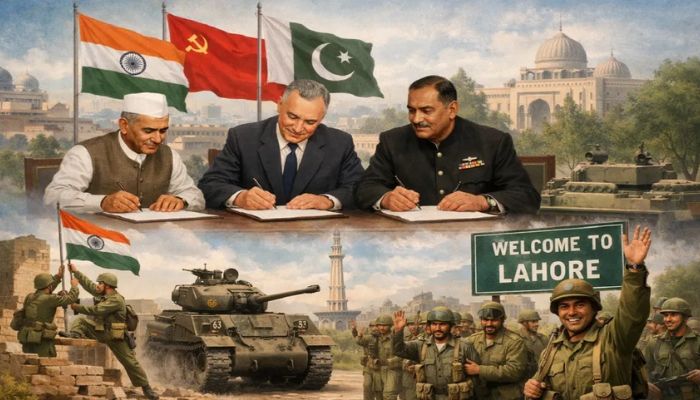

10th January, 1966, is a dark chapter in Indian history that still haunts us. On this day, an agreement was reached between India and Pakistan in Tashkent, known as the Tashkent Agreement. Under this agreement, the territories our brave soldiers had won in the 1965 war, risking their lives and shedding enemy blood, were simply returned at the negotiating table.
Imagine if the Tashkent Agreement hadn’t been reached, the city of Lahore would be part of India, not Pakistan. Our map would have looked so different and stronger. But that didn’t happen, and the then Congress government’s weak and pressure-stricken foreign policy was responsible for this. This single decision caused centuries of damage to the country, a price we still pay today.
Infiltration in Kashmir, terrorist incidents, attacks like Pulwama… all stem from that mistake. In this report, we will examine the entire story of that period in detail, so that lessons can be learned from history and such mistakes can be prevented from happening again.
Pakistan was badly defeated by India in 1965
The 1965 Indo-Pak War was primarily triggered by the Kashmir issue. Pakistan’s then-President, Ayub Khan, devised an ambitious plan, dubbed “Operation Gibraltar.” Under this operation, Pakistan sent thousands of infiltrators and soldiers into Jammu and Kashmir to incite locals to revolt and seize Kashmir. Ayub Khan was so arrogant that he declared that he would capture Delhi and have “dinner in Delhi.” However, the Indian Army shattered his dream.
Our soldiers not only apprehended the intruders but also retaliated against Pakistan. India’s Prime Minister at the time was Lal Bahadur Shastri, a simple but strong-willed leader. He told his soldiers, “We’ll have breakfast in Lahore tomorrow.”
This was not just a slogan, but a symbol of the courage of the Indian Army. And indeed, it would prove to be quite true during the war, as our soldiers reached the borders of Lahore. This war demonstrated how prepared and brave the Indian Army was, but political decisions changed everything.
Indian troops overwhelm from Kashmir to Kutch, enter Lahore sector as well
The war was fought on multiple fronts, and the Indian Army prevailed everywhere. In the Lahore sector, Indian troops destroyed Pakistani defence lines. We reached the Ichhogil Canal, considered the last line of defence for the city of Lahore. A further advance would have led to the capture of Lahore. Similarly, India captured strategically important areas like the Haji Pir Pass in Kashmir, a significant blow to Pakistan, as this pass controlled the infiltration route.
The Pakistani army was facing a crushing defeat. Thousands of its soldiers were killed, its most modern Patton tanks were destroyed, and its aircraft were shot down. India had clearly gained the upper hand. Pakistan suffered so many losses during the war that it was left with no fighting strength. Internationally, India was hailed as the victor, having not only defended itself but also entered enemy territory. But alas, this victory hung in the balance.
Stories of the bravery of Indian soldiers are still told today and fill us with pride. Consider, for example, the Battle of Asal Uttar. There, Pakistan’s most advanced Patton tanks were destroyed by the Indian Army. Our Sherman tanks overpowered them, demonstrating that courage is greater than weapons.
Officers like Major Bhupinder Singh sacrificed their lives in this battle, but they pushed the enemy back. Similarly, in the Chamb sector, our troops repelled Pakistani attacks and captured it. Pakistan suffered heavy losses, with over 4,000 soldiers killed, while India lost approximately 3,000 soldiers.
Over 200 Pakistani tanks were destroyed, while ours were only 80. In the air battle, the Indian Air Force shot down several Pakistani F-86 Sabre jets. The international media was also talking about India’s victory. But this is where the story changed, as political interference took hold, shifting the outcome of the war from the battlefield to the table.
The world was divided during the Cold War; talks were held at the invitation of the Soviet Union.
It was the era of the Cold War, when the world was divided into two camps: the United States on one side and the Soviet Union on the other. Both superpowers wanted to prevent an Indo-Pak war, which was spreading instability in Asia. The United States had supplied weapons to Pakistan, but when the war broke out, it halted arms supplies to both countries. The Soviet Union initiated mediation. Soviet Prime Minister Alexei Kosygin summoned India and Pakistan to Tashkent.
Our Prime Minister, Lal Bahadur Shastri, accepted the invitation and went to Tashkent. Pakistan was represented by Ayub Khan. Negotiations began, and pressure mounted. The Soviet Union wanted peace because it considered India an ally, but it also didn’t want to lose Pakistan. The United States was also exerting pressure from behind. This pressure on Shastri ji became so intense that, despite his strong position, he was forced to yield.
The government buckled under international pressure, and Nehru had initiated it
The Congress government came under international pressure, and this proved to be its biggest weakness. The United States had imposed an arms embargo, which was particularly damaging to Pakistan, which was dependent on American weapons, but India was also affected to some extent. The Soviet Union wanted peace and persuaded Shastri that continuing the war would be disastrous for both countries.
Shastriji was a strong leader, but the weak diplomacy of the Congress Party and its bureaucracy left him isolated. Party leaders and advisors buckled under pressure, as Congress’s long-standing policy was to yield to international pressure to secure peace. This trend had been ongoing since Nehru’s time, when he had even come close to victory in the 1948 war, taking the matter to the United Nations, thus giving Pakistan an advantage. Shastriji was under so much pressure that he agreed to a compromise, even though victory was ours on the battlefield.
We handed over our conquered territories to the enemy.
The Tashkent Declaration was signed on 10th January, 1966, and this day proved to be a tragic turning point for India. The key points of the agreement were that both countries would vacate all territories occupied during the war and restore the status quo ante bellum, as it existed before 5th August, 1965. Furthermore, both countries would resolve their disputes peacefully and refrain from using force. Diplomatic relations would be normalised, trade and communication channels would be opened. There would be no interference in each other’s internal affairs, and prisoners of war would be treated humanely.
All this sounds good, like a major step towards peace, but in reality, India completely squandered its strategic advantage. We returned the Lahore sector, Sialkot, and key areas of Kashmir, while Pakistan gave up nothing. This agreement was one-sided, proving detrimental to India.
Returning Haji Pir Pass was India’s biggest mistake
Returning the Haji Pir Pass was a grave mistake, and this decision haunts us to this day. This pass was crucial to preventing infiltration into Kashmir, as it controlled the routes from Pakistan into India. Our soldiers had captured it in the war, but it was returned in the agreement. What was the result?
Pakistan later began sending terrorists through this route. The return of areas like Haji Pir was a major reason for the terrorism that spread in Kashmir in the 1980s and 1990s. Similarly, the territories captured in the Lahore sector were also returned. Had we retained these, Pakistan’s defense lines would have been weakened and its claim to Kashmir would have been further weakened. The security of Lahore city would have been affected, and Pakistan would never have been so aggressive. But Congress’s weak policy returned all this, giving Pakistan new strength.
Pakistan took advantage of India’s weakness in foreign policy
This submissive policy of the Congress party has been in place since Nehru’s time and has been the biggest weakness of India’s foreign policy. Even in the 1947-48 Kashmir War, Nehru stopped the war when it was close to victory and took the matter to the United Nations, which benefited Pakistan, and the Kashmir issue remains unresolved to this day. Congress suffered the consequences of its weak preparation and policy in the 1962 China War. The same thing happened in 1965; standing on the brink of victory, Congress surrendered everything. This was a political weakness, as the party buckled under international pressure.
Nehru’s policy of nonviolence and peace was good, but it proved so weak in the face of the enemy that it cost the country dearly. Even strong leaders like Shastri fell victim to this policy. Had the Congress taken a firmer stance, history would have been different.
Ayub Khan became a hero despite losing
India suffered minimal losses in the war, proving how clear our victory was. Over 4,000 Pakistani soldiers were killed, while India lost nearly 3,000. Over 200 Pakistani tanks were destroyed, and their F-86 Sabre jets were shot down. Our soldiers pushed back the enemy in Sialkot, Lahore, and the Rann of Kutch.
But the Tashkent Agreement evened the waters . Pakistan was given a new lease of life, even though it had been defeated. Ayub Khan returned home a hero because he had lost nothing. India proved itself weak by returning the captured territory. This decision was the result of Congress’s weak leadership.
Even today, there is a demand for an inquiry into Shastri’s death.
Shastri’s mysterious death on 11th January, 1966, the day after the agreement, remains a mystery to this day. Officially, it was attributed to a heart attack, but many questions arose. His body turned blue, suggesting poisoning. A postmortem was not conducted, further fueling suspicion. The family suspected poisoning and claimed Shastri was unhappy with the agreement. Some allege a Soviet or Pakistani conspiracy, as the Soviets wanted the agreement and Pakistan benefited from Shastri’s death. This death sparked numerous theories about the agreement, and even today, demands for an investigation persist. Shastri’s death shocked the entire nation.
Shastriji was a strong leader, and his slogan “Jai Jawan Jai Kisan” still resonates today. He rescued the country from a food crisis and boosted the morale of the army during the war. However, the Congress party’s old policies put him under pressure. Had he asked for more time or taken a firmer stance, the outcome might have been different. His death plunged the nation into mourning, and criticism of the agreement increased. People say that Shastriji was unhappy with the agreement and this stress led to his death.
Criticism in both India and Pakistan
The Tashkent Agreement was met with strong criticism in India, and understandably so. People took to the streets, demonstrating. Disillusionment spread even within the military, as no one was willing to return the land the soldiers had won with their blood. Opposition parties accused the Congress of weakness, saying this amounted to treason. This proved that Congress’s foreign policy had always yielded to pressure and failed to protect national interests.
The agreement was also criticised in Pakistan, as it achieved nothing in Kashmir. However, it did regain Indian territory, which was a significant relief. Tashkent allowed Pakistan to spread terrorism. Returning Haji Pir facilitated infiltration, leading to decades of unrest in Kashmir.
India is still suffering the consequences of Congress’s mistakes.
Today, when attacks like Pulwama and Uri occur, we remember Tashkent. If India had those areas, Pakistan would not have been so strong, and terrorism would not have been so deeply rooted. The country continues to suffer from this Congress‘s mistake, with thousands of lives lost. The current government has changed its policy. Operations like the surgical strike and Balakot demonstrate that we no longer bow to pressure. The enemy retaliates. This change was necessary. Strong diplomacy is needed to prevent a mistake like Tashkent.
Had the Tashkent Agreement not been signed, Lahore and Sialkot would have remained part of India.
Had the Tashkent Agreement not been reached, the map would have been different. Cities like Lahore and Sialkot would have belonged to India, and Pakistan would not have become such a significant threat.
Even today, 60 years later, the lesson remains: even after winning a war, one must remain vigilant. Negotiations are good, but compromising on national interests is not. Learning from Congress’s past policies, India is becoming stronger today, and the enemy is being given a befitting reply. This is a painful historical event. The sacrifices of our soldiers deserve respect, not retribution. The Tashkent Agreement reminds us of this and shows us how high the cost of weakness is.
(This article is a translation of the original article published on OpIndia Hindi.)