Madras HC strikes down order of DMK govt that allowed commercial use of surplus funds of historic Kallazhagar temple: Read what the court said
The Madras High Court (Madurai Bench) has struck down a Tamil Nadu government order that allowed commercial activities to be carried out using surplus funds of the historic Kallazhagar Temple in Madurai district. The court made it clear on 23rd January that temples cannot be treated like development projects and that any activity carried out in the name of ‘development’ must strictly align with the religious ethos of the institution and the law governing temple administration. A division bench of Justice Anita Sumanth and Justice C. Kumarappan quashed the government order issued on 8th March, 2024, which had permitted the construction of restaurants, shopping complexes, cottages and other commercial facilities using temple funds. The bench held that the order was legally unsustainable and violated multiple provisions of the Tamil Nadu Hindu Religious and Charitable Endowments (HR&CE) Act. HUGE VICTORY for Hindu Devotees!A historic judgment by the Hon'ble Division Bench Madras High Court paves the way to restore the sanctity of Temple Administration!The Madurai Bench of Madras HC of Hon. Justice Dr. Anita Sumanth and Hon. Justice Shri C. Kumarappan(Order… pic.twitter.com/P2OhD0NB0K— trramesh (@trramesh) January 27, 2026 The court observed that the move reflected a worrying trend where the State was attempting to treat temple resources as its own, without following the statutory framework meant to protect religious institutions. judgmentDownload Court says temple development must align with its ethos While delivering the judgment, the High Court underlined that temples are not commercial spaces and cannot be reimagined as infrastructure projects. The judges strongly criticised the approach adopted by the HR&CE Department, stating that its primary role is to preserve and protect temples, not convert them into revenue-generating ventures. “Sections 35, 36, 66, 67 and 86 of the HR & CE Act, as well as the ‘Maintenance of Incorporated Devaswoms out of Devaswoms Fund Rules’, ‘Utilisation of Surplus Funds Rules’ and other Rules, stipulate that the incurrence of expenditure for temple upkeep should be only out of current receipts and not accumulated surpluses. The reserves of the temple have been depleted by the State in an irresponsible and illegal manner, and constitute a violation of the Act and Rules,” the court observed. The court noted that the department had wrongly viewed the Kallazhagar Temple as a “project” requiring modern development and upgradation. “Instead, the department has envisioned the temple as a ‘project’ requiring development and upgradation, concepts that are alien to a temple,” the judges remarked. According to the bench, providing basic facilities for devotees is necessary, but such activities must never compromise the spiritual character of the institution or bypass legal safeguards. Illegal use of temple funds without budget approval One of the strongest reasons for quashing the government order was the complete failure to follow the mandatory budgeting and approval process under the HR&CE Act. The court pointed out that large-scale expenditure had been planned without preparing a proper budget or obtaining approval from the temple’s Board of Trustees. Under Section 86 of the HR&CE Act, a detailed procedure exists for budget approval, including scrutiny by the HR&CE Commissioner, exchange of views, clarifications and exclusion of unauthorised expenses. The court found that none of these steps had been followed. “There is no material to show that the trustees applied their mind to the necessity or legality of the expenditure,” the bench observed. The court further held that funds belonging to a religious institution cannot be diverted for commercial purposes without proper sanction and oversight, especially when such decisions involve crores of rupees. Sharp decline in temple surplus raises red flags The judges expressed serious concern over the rapid depletion of the temple’s accumulated surplus. Based on audited accounts produced before the court, the bench noted that the surplus had reduced drastically over a short period. The temple’s accumulated surplus stood at ₹96.6 crore in March 2021, rose to ₹107.60 crore by March 2023, but dropped sharply to ₹62.37 crore by March 2024. “This reduction represents expenditure incurred without budgeting for the same and is without the sanction or authority of law. It is a crime against the deity and a clear illustration of the fence eating the crops,” the court said in a strong observation. According to the judges, such unauthorised spending was not just illegal but a betrayal of the trust placed in authorities managing temple finances. Absence of Board of Trustees weakens legality The court also took note of the fact that the term of the temple’s Board of Trustees had expired, and no new board had been constituted as required under law. Despite the statutory mandate under Sectio
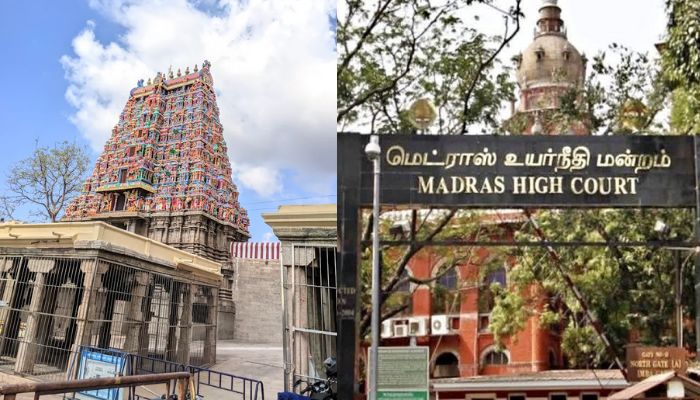

The Madras High Court (Madurai Bench) has struck down a Tamil Nadu government order that allowed commercial activities to be carried out using surplus funds of the historic Kallazhagar Temple in Madurai district.
The court made it clear on 23rd January that temples cannot be treated like development projects and that any activity carried out in the name of ‘development’ must strictly align with the religious ethos of the institution and the law governing temple administration.
A division bench of Justice Anita Sumanth and Justice C. Kumarappan quashed the government order issued on 8th March, 2024, which had permitted the construction of restaurants, shopping complexes, cottages and other commercial facilities using temple funds. The bench held that the order was legally unsustainable and violated multiple provisions of the Tamil Nadu Hindu Religious and Charitable Endowments (HR&CE) Act.

Related Posts







Bangladesh: Hindu mechanic burnt to death in his workshop
A 23-year-old Hindu mechanic, Chanchal Chandra Bhowmik, was tragically burnt alive...
'Will consider if ... ': BCB gives Hasina-linked cricketer...
Bangladesh cricket officials are considering a return for former captain Shakib...

Body found by cops not that of wife, man acquitted after...
A man jailed for eight years for his wife's murder has been acquitted. The court...

Happy Republic Day 2026: Wishes to share with friends and...
Republic Day, celebrated annually on January 26th, commemorates India's adoption...
'MS Dhoni to bat at No.3 in the Powerplay': R Ashwin drops...
MS Dhoni, at 44, is training intensely for IPL 2026, sparking speculation about...
Money Mantra Ep 7 | How to turn stock market trading into...
Money Mantra Ep 7 | How to turn stock market trading into a full-time career, ft....
Money Mantra Ep 6 | How to be a successful venture capitalist,...
Money Mantra Ep 6 | How to be a successful venture capitalist, ft Sudhir Sethi

Money Mantra Ep 5 | Labour Law Advisor founders Rishabh...
Money Mantra Ep 5 | Labour Law Advisor founders Rishabh Jain and Mandeep Gill share...
Dhan Ki Baat | Role of policy making in financial literacy
Dhan Ki Baat | Role of policy making in financial literacy

Money Mantra Ep 4 | How content creator Neha Nagar mixes...
Money Mantra Ep 4 | How content creator Neha Nagar mixes finance education with...