Maneka Gandhi’s remarks irresponsible and should invite contempt: Read what SC said on callous statements by former minister over stray dogs issue
On 20th January, the Supreme Court of India came down heavily on former Union Minister and controversial animal activist Maneka Gandhi for her remarks against the court’s orders on stray dogs. The court observed that her remarks amounted to “contempt of court”. In a sharp rebuke, the bench remarked that even Ajmal Kasab, the terrorist involved in the 26/11 Mumbai terror attack, “did not commit contempt”, unlike Gandhi. Notably, senior advocate Raju Ramachandran, who appeared for Gandhi, argued that he had appeared for Kasab as well, a comment that led to the sharp rebuke by the court. The court, however, refrained from initiating contempt proceedings against her due to its “magnanimity”. The three judge bench comprising Justice Vikram Nath, Justice Sandeep Mehta and Justice N V Anjaria was hearing a suo motu case on the stray dog issue and public safety concerns. Court defends its earlier oral observations At the beginning of the hearing, advocate Prashant Bhushan objected to oral remarks made by the bench during the previous proceedings, including remarks where the court said it would impose fines on dog feeders for dog bite cases. Bhushan stated that such comments often get “misinterpreted” once reported. Justice Mehta responded that the observations were made in response to what the court described as “unrealistic arguments” advanced on behalf of dog lovers. Bhushan: feeders are being beaten up etc. and they are taking refuge under these remarks. Court: these are made during oral arguments during conversation with counsel. Doesn’t make any difference. Sorry. Sr. Adv. Raju Ramachandran: these things are being televised. Therefore…— Bar and Bench (@barandbench) January 20, 2026 When Bhushan suggested that the court’s remark about holding dog feeders responsible was sarcastic, Justice Mehta firmly denied it, stating that the bench was “serious” and not being sarcastic at all. ‘Have you seen what your client has been saying?’ Ramachandran, while arguing the matter, said that since proceedings were televised, both the Bar and the Bench had a duty to remain circumspect. This prompted Justice Vikram Nath to ask whether he had examined the nature of statements made by his client outside court. “Your client has committed contempt. We have not taken action, that is our magnanimity. Have you seen what she says, her body language?” Justice Nath remarked. Sr. Adv. Raju Ramachandran begins his submissions. Ramachandran: I appear for an animal rights activist and a union cabinet minister. Justice Nath: a little while ago you were telling the court we should be circumspect. Did you find out what kind of remarks your client has…— Bar and Bench (@barandbench) January 20, 2026 When Ramachandran stated that he had previously appeared for Ajmal Kasab as amicus curiae, the bench responded sharply. “Ajmal Kasab did not commit contempt of court, but your client has,” Justice Nath said. Questions over policy, funding, and accountability During submissions, Ramachandran argued that effective implementation of the Animal Birth Control Rules and the National Action Plan for Rabies Elimination was crucial to resolving the stray dog problem. He pointed out that while NAPRE clearly identified hurdles and assigned responsibilities, over 30 states had failed to formulate their mandated action plans. The bench, however, questioned why Gandhi’s application was silent on budgetary allocation. Justice Mehta asked what contribution Gandhi had made towards funding or implementing these policies during her tenure as a Union Minister and animal rights advocate. Ramachandran replied that he could not provide an oral answer to the query. Comments by Maneka Gandhi The court’s observations stem from Maneka Gandhi’s earlier public criticism of Supreme Court directions ordering the removal of stray dogs from sensitive locations such as schools, hospitals, and bus and railway stations. She had termed the orders “impractical”, questioned their feasibility, and criticised what she described as a lack of coordination and infrastructure. #WATCH | SC ordered removal of all stray dogs from the premises of educational institutions, hospitals, bus and railway stations and directed that they won’t be released back in the same area after sterilisation.Animal rights activist & BJP leader Maneka Gandhi says, "This is… pic.twitter.com/ticMUrhtDS— ANI (@ANI) November 7, 2025 While the bench did not specify which of Gandhi’s remarks amounted to contempt, it made clear that public comments undermining the authority of the court would not be tolerated, even as it chose restraint for now. Parents of deceased minor allege hospital negligence, court bars speculation on cause of death During the hearing, the parents of the six year old girl whose death led the Supreme Court to take suo motu cognisance of the stray dog menace also made submissions. Advocate Jasdeep Dhillon appeared for the parents. He informed th
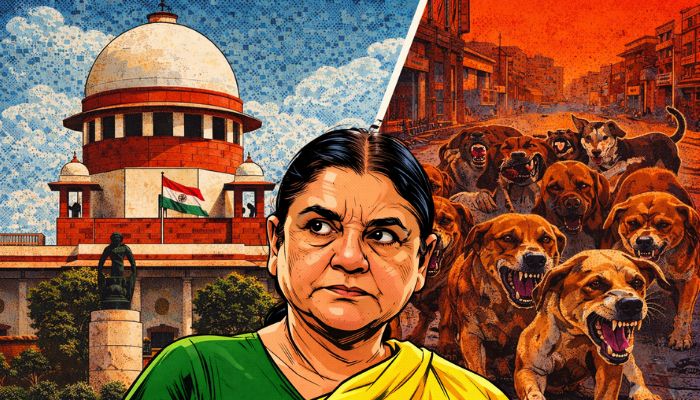

On 20th January, the Supreme Court of India came down heavily on former Union Minister and controversial animal activist Maneka Gandhi for her remarks against the court’s orders on stray dogs. The court observed that her remarks amounted to “contempt of court”.
In a sharp rebuke, the bench remarked that even Ajmal Kasab, the terrorist involved in the 26/11 Mumbai terror attack, “did not commit contempt”, unlike Gandhi. Notably, senior advocate Raju Ramachandran, who appeared for Gandhi, argued that he had appeared for Kasab as well, a comment that led to the sharp rebuke by the court. The court, however, refrained from initiating contempt proceedings against her due to its “magnanimity”.
The three judge bench comprising Justice Vikram Nath, Justice Sandeep Mehta and Justice N V Anjaria was hearing a suo motu case on the stray dog issue and public safety concerns.
Court defends its earlier oral observations
At the beginning of the hearing, advocate Prashant Bhushan objected to oral remarks made by the bench during the previous proceedings, including remarks where the court said it would impose fines on dog feeders for dog bite cases. Bhushan stated that such comments often get “misinterpreted” once reported. Justice Mehta responded that the observations were made in response to what the court described as “unrealistic arguments” advanced on behalf of dog lovers.
Bhushan: feeders are being beaten up etc. and they are taking refuge under these remarks.
— Bar and Bench (@barandbench) January 20, 2026
Court: these are made during oral arguments during conversation with counsel. Doesn’t make any difference. Sorry.
Sr. Adv. Raju Ramachandran: these things are being televised. Therefore…
When Bhushan suggested that the court’s remark about holding dog feeders responsible was sarcastic, Justice Mehta firmly denied it, stating that the bench was “serious” and not being sarcastic at all.
‘Have you seen what your client has been saying?’
Ramachandran, while arguing the matter, said that since proceedings were televised, both the Bar and the Bench had a duty to remain circumspect. This prompted Justice Vikram Nath to ask whether he had examined the nature of statements made by his client outside court. “Your client has committed contempt. We have not taken action, that is our magnanimity. Have you seen what she says, her body language?” Justice Nath remarked.
Sr. Adv. Raju Ramachandran begins his submissions.
— Bar and Bench (@barandbench) January 20, 2026
Ramachandran: I appear for an animal rights activist and a union cabinet minister.
Justice Nath: a little while ago you were telling the court we should be circumspect. Did you find out what kind of remarks your client has…
When Ramachandran stated that he had previously appeared for Ajmal Kasab as amicus curiae, the bench responded sharply. “Ajmal Kasab did not commit contempt of court, but your client has,” Justice Nath said.
Questions over policy, funding, and accountability
During submissions, Ramachandran argued that effective implementation of the Animal Birth Control Rules and the National Action Plan for Rabies Elimination was crucial to resolving the stray dog problem. He pointed out that while NAPRE clearly identified hurdles and assigned responsibilities, over 30 states had failed to formulate their mandated action plans.
The bench, however, questioned why Gandhi’s application was silent on budgetary allocation. Justice Mehta asked what contribution Gandhi had made towards funding or implementing these policies during her tenure as a Union Minister and animal rights advocate. Ramachandran replied that he could not provide an oral answer to the query.
Comments by Maneka Gandhi
The court’s observations stem from Maneka Gandhi’s earlier public criticism of Supreme Court directions ordering the removal of stray dogs from sensitive locations such as schools, hospitals, and bus and railway stations. She had termed the orders “impractical”, questioned their feasibility, and criticised what she described as a lack of coordination and infrastructure.
#WATCH | SC ordered removal of all stray dogs from the premises of educational institutions, hospitals, bus and railway stations and directed that they won’t be released back in the same area after sterilisation.
— ANI (@ANI) November 7, 2025
Animal rights activist & BJP leader Maneka Gandhi says, "This is… pic.twitter.com/ticMUrhtDS
While the bench did not specify which of Gandhi’s remarks amounted to contempt, it made clear that public comments undermining the authority of the court would not be tolerated, even as it chose restraint for now.
Parents of deceased minor allege hospital negligence, court bars speculation on cause of death
During the hearing, the parents of the six year old girl whose death led the Supreme Court to take suo motu cognisance of the stray dog menace also made submissions. Advocate Jasdeep Dhillon appeared for the parents. He informed the court that multiple hospitals were guilty of negligence as they refused timely treatment to the child.
He submitted that while the child received three doses of the rabies vaccine at Ambedkar Hospital in Rohini, she was referred from one hospital to another for treatment for her injuries, including Safdarjung Hospital, Ram Manohar Lohia Hospital, and Lady Hardinge Hospital. All of them, according to Dhillon, refused to treat her citing one reason or another.
Adv Jasdeep Dhillon: this is an article 32 petition. It considers a 6 year old victim. My prayer is that action should be taken. No enquiry. Negligence at the hospital level also. 30th June 2025 the victim was viciously bitten. She got her first dose the same day. We got to know…
— Bar and Bench (@barandbench) January 20, 2026
Dhillon further told the court that the stray dog which attacked the child had previously bitten at least four other people in the area, yet no remedial action was taken by the authorities. Responding to a query from the bench on the cause of death, he stated that it was a case of acute viral illness following a dog bite.
After Dhillon completed his submissions, some counsels appearing for the dog lovers attempted to contest the cause of death. They argued that the post mortem report was not conclusive and that rabies could only be confirmed through brain tissue analysis. One counsel even claimed that the child was eating and drinking in her final days, which, according to her, was inconsistent with rabies.
Adv Jasmin Damkewala: for confirmation of rabies the brain tissue analysis has to be done.
— Bar and Bench (@barandbench) January 20, 2026
Court: do not comment on that. Stick to your IA.
Damkewala: as far as feeding is concerned, my note talks about scientific studies by the Centre for disease control. Feeding reduces…
The bench reacted strongly to these submissions. “You are trying to suggest her death was due to natural causes?” Justice Sandeep Mehta remarked, before prohibiting any further arguments or speculation on the child’s death. Both Justice Vikram Nath and Justice Mehta directed counsels to refrain from commenting on the facts of the case.
Furthermore, another counsel appearing for a victim of a dog attack pointed out that there is no mechanism to fix responsibility when a stray dog repeatedly bites people. He further argued that since animals are slaughtered for human consumption, violent stray dogs should also be firmly dealt with in the interest of public safety.
Stray dog menace in India
The ongoing proceedings have brought the issue of the stray dog menace into the limelight since the hearing began in August last year. The stray dog issue is not a peripheral civic concern but a nationwide public safety crisis that the system has repeatedly failed to confront properly.
Since the Animal Birth Control Rules came into effect in 2001, the stray dog population and dog bite incidents have sharply increased across the country. Though there was a dip in stray dog bite cases in 2020 and the following years, this can be attributed to the COVID 19 pandemic, as the nation was under strict lockdown.
When the lockdown was lifted, stray dog bite incidents began to rise again and, over the years, have increased sharply in number. Altercations between dog lovers and the general public have also increased due to safety concerns. The Supreme Court took cognisance of the matter after a six year old child died of rabies. Several orders have since been passed by the court, including the removal of dogs from public and private institutions such as colleges, hospitals, schools, railway stations, and bus stands.
Years of policy paralysis, selective activism, weak enforcement of existing rules, and the absence of accountability have ensured that responsibility is endlessly deflected while victims, often children and the elderly, pay the price. Now, as the apex court is hearing the matter to bring a balance between compassion and public safety, the larger question remains unresolved, whether human life will finally be placed above ideological posturing, and whether governments and institutions will be compelled to act decisively rather than hide behind frameworks that exist largely on paper.
The hearing will continue on 28th January at 2 pm, with the court set to hear further submissions from the amicus curiae, and states and UTs.
OpIndia is doing a series on Stray Dog Menace that can be checked here.