What is rat-hole mining? As the Meghalaya explosion kills 30, read why this practice continues despite govt ban and court orders
On 5th February (Thursday), an explosion took place in an illegally run rat-hole coal mine in the East Jaintia Hills area of Meghalaya, which resulted in 30 fatalities. The figures also include those who succumbed to their wounds. The tragedy happened at an unlawfully operated coal mine in the remote Thangsku neighbourhood of Mynsngat village. According to reports, 8 individuals are admitted at the Shillong hospital with three more at the Silchar hospital. This ranked among the most significant mishaps since July 2012, when a flooded mine in the South Garo Hills district of the state claimed the lives of 15 miners. Afterwards, the dangerous mining technique was outlawed by the National Green Tribunal (NGT). Image via d-maps.com Meghalaya High Court heard testimonies from the East Jaintia Hills district’s Deputy Commissioner Manish Kumar and Superintendent of Police Vikash Kumar regarding the matter and sought a thorough report on the actions taken by the authorities to put an end to such illicit activities. They were told to “furnish reasons as to why the situation has been allowed to continue.” The Division Bench of Justices HS Thangkhiew and W Diengdoh also voiced grave concerns over the blast and the state’s persistent unsanctioned coal mining instances. They severely criticised the state apparatus for its inability to prevent prohibited rat-hole coal mining in the East Jaintia Hills area, describing the situation as “distressing” and warning to impose responsibility if the violations continued to exist. “The report is distressing and reflects dereliction in the discharge of duties by the authorities concerned,” the court stated. The district administration’s status report informed that two arrests were carried out and a criminal case had been filed but it also mentioned a lack of manpower. The Meghalaya Human Rights Commission (MHRC) took suo motu cognisance and demanded a detailed report from the government. Search and rescue efforts involving the National Disaster Response Force (NDRF), State Disaster Response Force (SDRF), Special Rescue Team (SRT), police and district administration were officially concluded at 5 pm on Monday. 24 bodies were found in the 100-foot-deep chain of low and narrow tunnels. How the Meghalaya government reacted Chief Minister Conrad K Sangma declared that the state government would launch a judicial inquiry commission to probe the occurrence, determine the cause of the catastrophe and assign accountability. The district administration similarly increased its efforts against unauthorised mining in the wake of the disastrous event. #WATCH | Meghalaya's East Jaintia Hills coal mine incident | Rescue operations underway at the blast site to rescue the trapped mine workers.25 people died in the blast that took place in an illegal rat-hole coal mine on 5th February. pic.twitter.com/zR8qzMKLP2— ANI (@ANI) February 7, 2026 Nearly, 38 metric tonnes of coal that had been mined were confiscated from multiple areas, including the villages of Lumshyrmit–Cham Cham, Mukhaialong, Mutong and Pynthorsale by joint teams of Executive Magistrates, police officers and representatives from the Directorate of Mineral Resources (DMR). Furthermore, authorities located and destroyed temporary camps associated with these perilous mining ventures while First Information Reports (FIRs) have been lodged and additional legal action is ongoing. The families of 8 victims have already received ₹24 lakh (3 lakh for each next of kin) in compensation from the government. According to officials, payments are set to resume once the documentation of the remaining families has been confirmed. Assam has likewise offered ₹5 lakh to each victim from the state. Prime Minister Narendra Modi also conveyed that the Prime Minister’s National Relief Fund (PMNRF) would grant ₹2 lakh for the departed and ₹50,000 for the wounded. Image via The Assam Tribune All magistrates in Thangkso were tasked by the district administration to carry out inspections, seize cars, machinery and equipment employed in this forbidden work, as well as locate and apprehend financiers, mine owners, operators and “any people involved in illegal mining activities.” The district magistrate has issued prohibitory orders under Section 163 of the Bharatiya Nagarik Suraksha Sanhita (BNSS) in the impacted regions to maintain public safety alongside law and order. It mentioned “serious likelihood of obstruction to law enforcement by certain individuals or groups during operations against illegal mining activities.” The government has encouraged the citizens to assist authorities, abstain from illegal mining and stay out of dangerous or restricted areas. The police earlier submitted a suo motu FIR at the Khliehriat (district headquarters) police station with pertinent provisions of the Bharatiya Nyaya Sanhita, Mines and Minerals (Development and Regulation) Act, along with the Explosives Substances Act.
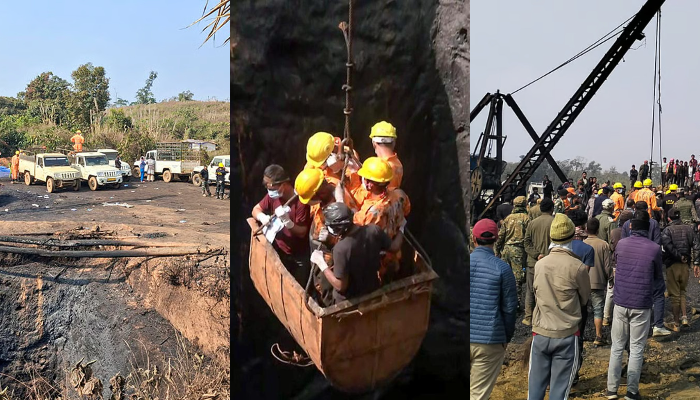

On 5th February (Thursday), an explosion took place in an illegally run rat-hole coal mine in the East Jaintia Hills area of Meghalaya, which resulted in 30 fatalities. The figures also include those who succumbed to their wounds. The tragedy happened at an unlawfully operated coal mine in the remote Thangsku neighbourhood of Mynsngat village. According to reports, 8 individuals are admitted at the Shillong hospital with three more at the Silchar hospital.
This ranked among the most significant mishaps since July 2012, when a flooded mine in the South Garo Hills district of the state claimed the lives of 15 miners. Afterwards, the dangerous mining technique was outlawed by the National Green Tribunal (NGT).

Meghalaya High Court heard testimonies from the East Jaintia Hills district’s Deputy Commissioner Manish Kumar and Superintendent of Police Vikash Kumar regarding the matter and sought a thorough report on the actions taken by the authorities to put an end to such illicit activities. They were told to “furnish reasons as to why the situation has been allowed to continue.”
The Division Bench of Justices HS Thangkhiew and W Diengdoh also voiced grave concerns over the blast and the state’s persistent unsanctioned coal mining instances. They severely criticised the state apparatus for its inability to prevent prohibited rat-hole coal mining in the East Jaintia Hills area, describing the situation as “distressing” and warning to impose responsibility if the violations continued to exist.
“The report is distressing and reflects dereliction in the discharge of duties by the authorities concerned,” the court stated. The district administration’s status report informed that two arrests were carried out and a criminal case had been filed but it also mentioned a lack of manpower.
The Meghalaya Human Rights Commission (MHRC) took suo motu cognisance and demanded a detailed report from the government. Search and rescue efforts involving the National Disaster Response Force (NDRF), State Disaster Response Force (SDRF), Special Rescue Team (SRT), police and district administration were officially concluded at 5 pm on Monday. 24 bodies were found in the 100-foot-deep chain of low and narrow tunnels.
How the Meghalaya government reacted
Chief Minister Conrad K Sangma declared that the state government would launch a judicial inquiry commission to probe the occurrence, determine the cause of the catastrophe and assign accountability. The district administration similarly increased its efforts against unauthorised mining in the wake of the disastrous event.
#WATCH | Meghalaya's East Jaintia Hills coal mine incident | Rescue operations underway at the blast site to rescue the trapped mine workers.
— ANI (@ANI) February 7, 2026
25 people died in the blast that took place in an illegal rat-hole coal mine on 5th February. pic.twitter.com/zR8qzMKLP2
Nearly, 38 metric tonnes of coal that had been mined were confiscated from multiple areas, including the villages of Lumshyrmit–Cham Cham, Mukhaialong, Mutong and Pynthorsale by joint teams of Executive Magistrates, police officers and representatives from the Directorate of Mineral Resources (DMR).
Furthermore, authorities located and destroyed temporary camps associated with these perilous mining ventures while First Information Reports (FIRs) have been lodged and additional legal action is ongoing. The families of 8 victims have already received ₹24 lakh (3 lakh for each next of kin) in compensation from the government. According to officials, payments are set to resume once the documentation of the remaining families has been confirmed.
Assam has likewise offered ₹5 lakh to each victim from the state. Prime Minister Narendra Modi also conveyed that the Prime Minister’s National Relief Fund (PMNRF) would grant ₹2 lakh for the departed and ₹50,000 for the wounded.

All magistrates in Thangkso were tasked by the district administration to carry out inspections, seize cars, machinery and equipment employed in this forbidden work, as well as locate and apprehend financiers, mine owners, operators and “any people involved in illegal mining activities.”
The district magistrate has issued prohibitory orders under Section 163 of the Bharatiya Nagarik Suraksha Sanhita (BNSS) in the impacted regions to maintain public safety alongside law and order. It mentioned “serious likelihood of obstruction to law enforcement by certain individuals or groups during operations against illegal mining activities.”
The government has encouraged the citizens to assist authorities, abstain from illegal mining and stay out of dangerous or restricted areas. The police earlier submitted a suo motu FIR at the Khliehriat (district headquarters) police station with pertinent provisions of the Bharatiya Nyaya Sanhita, Mines and Minerals (Development and Regulation) Act, along with the Explosives Substances Act.
What is rat hole mining?
Rat hole mining is an archaic and unscientific technique for removing coal from slender and horizontal seams in Meghalya. The land is cleared by chopping and removing the vegetation, after which pits are created to access the coal seam. A coal seam is a visible, dark brown or black-banded coal deposit formed inside rock layers.

The narrow trenches that are excavated into the ground are usually only big enough for one person to descend and retrieve coal. These are referred to as “rat holes.” Miners utilise bamboo ladders or ropes to navigate the coal seams when the pits are dug. The coal is manually removed using equipment like baskets, shovels and pickaxes. The mining is executed via two methods known as the side-cutting procedure and box cutting.
People enter the narrow tunnels built on the hill slopes, merely 3-4 feet deep, usually only big enough for one person to crawl inside and out, and proceed until they reach the coal seam, which is less than 2 metres thick, as part of the side-cutting procedure. They must squat to extract coal.

Box-cutting involves carving a rectangular opening that is between 10 and 100 square meters in size and then making a vertical pit that is between 100 and 400 feet deep. Workers can extract coal by digging horizontal tunnels through the coal seam after it has been located. They go down with the help of rope-and-bamboo ladders or improvised cranes. The tunnels are constructed from the pit’s edge in all directions.
NGT slaps a ban in light of serious concerns
The Coal Mines Nationalisation Act of 1973 does not apply in Meghalaya, a Sixth Schedule State and the government has limited authority over the land. Therefore, the minerals underneath are also owned by the landowners. After Meghalaya became a state in January 1972, coal mining took off. However, mine owners did not adopt sophisticated drilling equipment due to the terrain and associated costs. Thus, people primarily from Assam, Nepal and Bangladesh began to enter the mines for better income.
However, these are prone to the risk of asphyxiation from inadequate ventilation, collapse from a lack of structural support, like side-wall protections and engineered roofs, as well as flooding. Moreover, uncontrolled mining resulted in soil degradation, deforestation, water with high concentrations of sulphates, iron and hazardous heavy metals, low dissolved oxygen, along with high biochemical oxygen demand, in addition to safety and health fears. The Lukha and Myntdu rivers became too corrosive to support aquatic life.

These concerns were first presented 20 years ago. The problem of child labour and human trafficking in these mines also surfaced. According to reports, kids were employed there owing to their small size. Hence, NGT introduced a blanket ban on rat hole mining in Meghalaya almost 2 decades ago in 2014 and reaffirmed it in 2015.
Likewise, illegal mining, transportation and storage are also prevented under the Meghalaya Minor Minerals Concession Rules and the framework related to Mines and Minerals Development and Regulation (MMDR) Act.
Why does rat hole mining continue despite the ban?
Rat-hole mining is a regular feature for unapproved setups and never ceased to exist despite the firm actions due to a significant local reliance on coal revenue, fragmented ownership and contractorships that disperse accountability and patronage. Their operators also avoid disclosing accidents and keep workers off official records because deaths make headlines, but injuries from child labour and contaminated water, acid drains, unstable terrain and deteriorated roads do not.
A major reason is the absence of economic opportunities, which compels the locals to pursue such jobs. This business is allowed to flourish in the northeastern states as it yields far more than the Mahatma Gandhi National Rural Employment Guarantee Act (MGNREGA) and other government-run programs. Furthermore, it is very challenging to separate illegal coal from legacy or auctioned coal after it has entered the supply chain.
On the other hand, the Meghalaya High Court assigned Justice (Retd) BP Katakey to serve as a one-man committee to oversee prohibited coal mining in the state since 2022 in response to a suo-motu Public Interest Litigation (PIL) and he drew attention to the fact that “no one in the state, except the high court, is taking it very seriously” despite repeated warnings of massive unlawful extraction in Meghalaya, especially in the East Jaintia Hills.
The court observed that the Justice Katakey committee had identified East Jaintia Hills as the district hardest hit where these forbidden activities are prominently prevalent alongside other incidents in its report submitted on 17th January.
It is evident that the rat hole mining continues because of institutional enforcement shortcomings, the huge demand for coal and the serious issue of poverty. Additionally, the problem is exacerbated by inadequate imposition of law and regulation, which are aided by the inept or vested political and administrative sectors.
However, the Justice Katakey committee suggested that the recurring problem could be resolved if the state and the central governments took decisive measures to effectively enforce mining constraints. Moreover, state-owned companies must be taken into account for the temporary management of mining operations. Mineral processing, value addition and related industries should be utilised to generate alternate sources of income for the populace.