When Communists in Iran were jailed and executed by the Islamic regime, as soon as Ruhollah Khomeini came to power after the 1979 revolution
The Middle East today stands on the edge of another historic rupture. With the death of Ayatollah Ali Khamenei in US-Israel strikes and Tehran launching retaliatory attacks across the region, the Islamic Republic appears to be entering one of the most uncertain moments in its four-decade history. Iranian missiles targeting American bases and urban centres like Dubai, Abu Dhabi, and Doha are a reminder that the geopolitical aftershocks of this event could reshape the region for years. Yet to understand the present crisis in Iran, one must revisit a profound historical irony. The theocratic regime that came to power in Tehran in 1979, one that would eventually become the standard-bearer of militant Islamist politics, was not merely the product of religious mobilisation. It was also aided, legitimised, and politically enabled by an unlikely alliance: Leftists, Marxists, and secular revolutionaries who believed the Islamic clergy represented a revolutionary anti-imperialist force. This alliance, built on ideological delusion and tactical opportunism, proved fatal. Within a few years of the revolution, the very Leftists who had supported Ayatollah Ruhollah Khomeini found themselves imprisoned, tortured, and executed by the Islamic regime they helped create. The story of this betrayal is one of the most striking examples of political self-destruction in modern history. The Revolution that united strange allies The Iranian Revolution of 1979 was not a purely Islamist uprising. In fact, it was a broad coalition of forces united by one objective: overthrowing the Shah, Mohammad Reza Pahlavi. The Shah’s regime had ruled Iran with an iron hand, backed by Western powers, particularly the United States. Opposition to him came from many directions, religious clerics, liberal nationalists, student movements, trade unions, and Marxist organisations. Communist groups like the Tudeh Party, leftist guerrilla organisations, secular intellectuals, and Islamist revolutionaries all found themselves fighting the same enemy. According to contemporary accounts, the revolution was driven by “a wide range of class and social forces, united on a program of democracy and anti-imperialism.” For many Leftists, Khomeini appeared to be an anti-imperialist leader capable of mobilising the masses against Western influence. The Islamic clergy, in turn, used the revolutionary fervour generated by workers, students, and intellectuals to overthrow the monarchy. Source: AP It was a tactical partnership born of convenience. But history would soon show that it was also a catastrophic miscalculation. The Left’s ideological blindness To understand why so many Marxists and secular revolutionaries supported Khomeini, one must examine the ideological climate of the 1970s. Across much of the world, particularly in the developing world, anti-Western sentiment was the dominant political narrative. Any movement opposing a regime perceived as aligned with the United States was automatically viewed as progressive. In Iran, the Shah was widely seen as a Western puppet. His government had come to power with the help of the CIA-backed coup that overthrew Prime Minister Mohammad Mossadegh in 1953. This historical memory deeply shaped Iranian political discourse. For many Leftists, the primary contradiction was not between secularism and religious authority but between imperialism and national sovereignty. Khomeini understood this sentiment well. During his exile in Paris, he carefully crafted rhetoric that appealed to secular revolutionaries, promising democracy, freedom, and independence. He even suggested that the future government would not be dominated by clerics. Many believed him. The moment the revolution changed When the Shah fled Iran in January 1979, celebrations erupted across the country. Millions poured into the streets as Khomeini returned from exile. For a brief moment, it appeared that Iran might embark on a democratic transformation. But within months, the direction of the revolution began to shift dramatically. The Islamic clergy rapidly consolidated power. Revolutionary courts were established. Secular institutions were dismantled. The new regime began enforcing Islamic laws across society. Universities were closed. Independent political organisations were banned. Women were pressured into adopting Islamic dress codes.What had begun as a multi-ideological revolution was becoming a theocratic state. The purge of the revolution’s allies The real turning point came in 1981. As opposition to clerical rule grew, the Islamic Republic launched a massive crackdown on dissent. Revolutionary courts conducted rapid trials and issued death sentences with alarming speed. Between June 1981 and March 1982, thousands of political opponents were executed across Iran. The victims included communists, socialists, liberals, nationalists, monarchists, and members of religious minoriti
The Middle East today stands on the edge of another historic rupture. With the death of Ayatollah Ali Khamenei in US-Israel strikes and Tehran launching retaliatory attacks across the region, the Islamic Republic appears to be entering one of the most uncertain moments in its four-decade history. Iranian missiles targeting American bases and urban centres like Dubai, Abu Dhabi, and Doha are a reminder that the geopolitical aftershocks of this event could reshape the region for years.
Yet to understand the present crisis in Iran, one must revisit a profound historical irony. The theocratic regime that came to power in Tehran in 1979, one that would eventually become the standard-bearer of militant Islamist politics, was not merely the product of religious mobilisation. It was also aided, legitimised, and politically enabled by an unlikely alliance: Leftists, Marxists, and secular revolutionaries who believed the Islamic clergy represented a revolutionary anti-imperialist force.
This alliance, built on ideological delusion and tactical opportunism, proved fatal. Within a few years of the revolution, the very Leftists who had supported Ayatollah Ruhollah Khomeini found themselves imprisoned, tortured, and executed by the Islamic regime they helped create.
The story of this betrayal is one of the most striking examples of political self-destruction in modern history.
The Revolution that united strange allies
The Iranian Revolution of 1979 was not a purely Islamist uprising. In fact, it was a broad coalition of forces united by one objective: overthrowing the Shah, Mohammad Reza Pahlavi.
The Shah’s regime had ruled Iran with an iron hand, backed by Western powers, particularly the United States. Opposition to him came from many directions, religious clerics, liberal nationalists, student movements, trade unions, and Marxist organisations.
Communist groups like the Tudeh Party, leftist guerrilla organisations, secular intellectuals, and Islamist revolutionaries all found themselves fighting the same enemy. According to contemporary accounts, the revolution was driven by “a wide range of class and social forces, united on a program of democracy and anti-imperialism.”
For many Leftists, Khomeini appeared to be an anti-imperialist leader capable of mobilising the masses against Western influence. The Islamic clergy, in turn, used the revolutionary fervour generated by workers, students, and intellectuals to overthrow the monarchy.
Source: AP
It was a tactical partnership born of convenience. But history would soon show that it was also a catastrophic miscalculation.
The Left’s ideological blindness
To understand why so many Marxists and secular revolutionaries supported Khomeini, one must examine the ideological climate of the 1970s.
Across much of the world, particularly in the developing world, anti-Western sentiment was the dominant political narrative. Any movement opposing a regime perceived as aligned with the United States was automatically viewed as progressive.
In Iran, the Shah was widely seen as a Western puppet. His government had come to power with the help of the CIA-backed coup that overthrew Prime Minister Mohammad Mossadegh in 1953.
This historical memory deeply shaped Iranian political discourse. For many Leftists, the primary contradiction was not between secularism and religious authority but between imperialism and national sovereignty.
Khomeini understood this sentiment well. During his exile in Paris, he carefully crafted rhetoric that appealed to secular revolutionaries, promising democracy, freedom, and independence.
He even suggested that the future government would not be dominated by clerics.
Many believed him.
The moment the revolution changed
When the Shah fled Iran in January 1979, celebrations erupted across the country. Millions poured into the streets as Khomeini returned from exile.
For a brief moment, it appeared that Iran might embark on a democratic transformation. But within months, the direction of the revolution began to shift dramatically.
The Islamic clergy rapidly consolidated power. Revolutionary courts were established. Secular institutions were dismantled. The new regime began enforcing Islamic laws across society.
Universities were closed. Independent political organisations were banned. Women were pressured into adopting Islamic dress codes.What had begun as a multi-ideological revolution was becoming a theocratic state.
The purge of the revolution’s allies
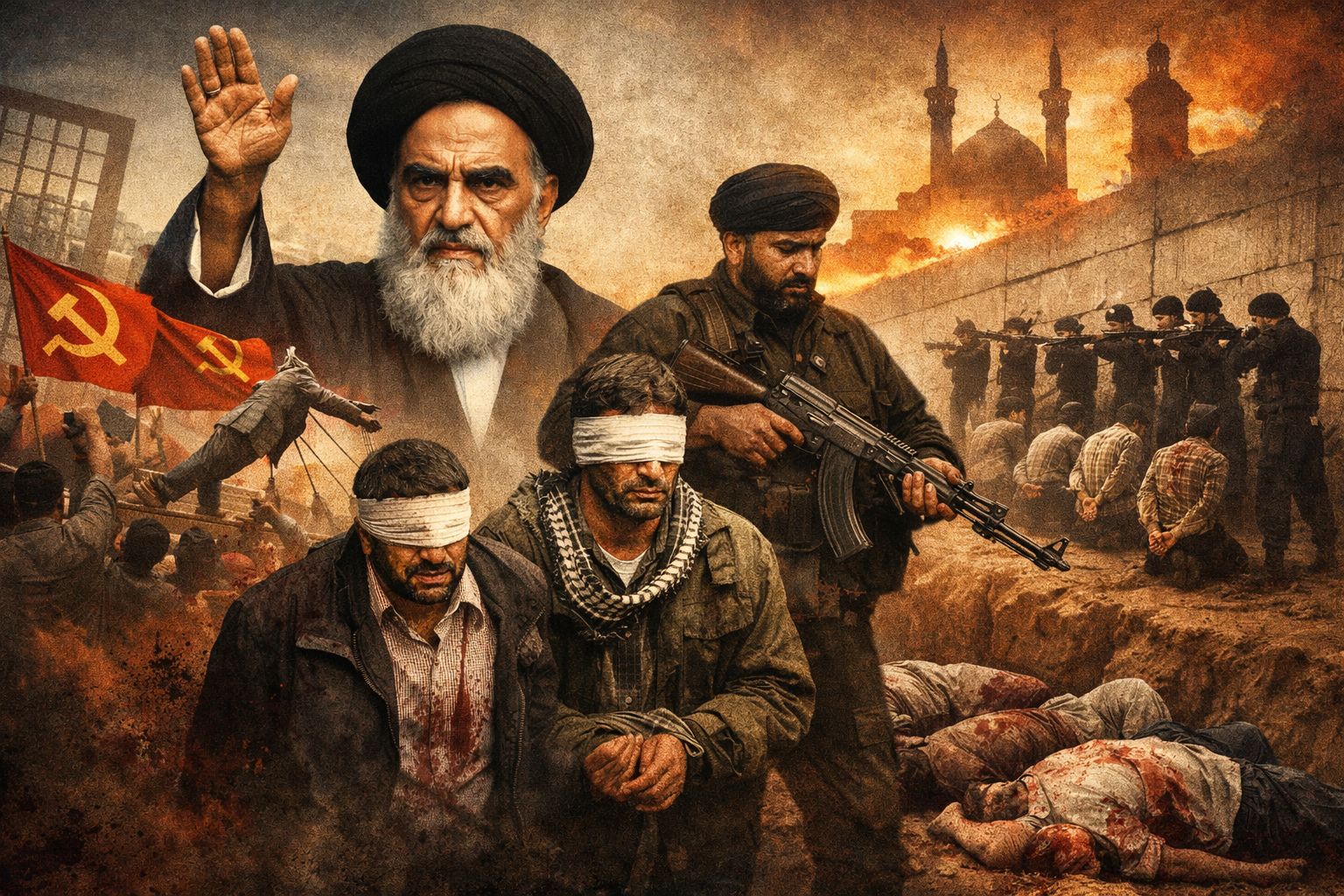
The real turning point came in 1981. As opposition to clerical rule grew, the Islamic Republic launched a massive crackdown on dissent. Revolutionary courts conducted rapid trials and issued death sentences with alarming speed.
Between June 1981 and March 1982, thousands of political opponents were executed across Iran. The victims included communists, socialists, liberals, nationalists, monarchists, and members of religious minorities.
Ironically, many of them were the same revolutionaries who had helped overthrow the Shah.
The massacre became one of the largest waves of political executions in modern Iranian history. Estimates suggest that thousands of dissidents were killed in a matter of months.
These executions were not merely acts of repression; they were foundational acts of state formation.The new regime used violence to eliminate alternative centres of political power.
The role of revolutionary courts
Central to this purge were the Islamic Revolutionary Courts.These courts operated without due process. Defendants were often denied lawyers, trials lasted minutes, and verdicts were predetermined.
Judges used vague religious charges such as “waging war against God” (moharebeh) or “spreading corruption on Earth” (ifsad-fi-alarz) to justify executions.
These concepts were later codified into Iran’s legal system, forming the basis of the Islamic Penal Code adopted in 1982.
When revolution devours its children
The irony of the Iranian Revolution is that the Left helped create the conditions for its own destruction.
Communist groups that had once celebrated the overthrow of the Shah soon found themselves banned and persecuted.
The Tudeh Party, which had supported the Islamic Republic in its early years, was eventually outlawed. Thousands of its members were arrested, tortured, or executed. The revolution had devoured its children.
This pattern is not unique in history. Many revolutions eventually turn on their early supporters. But the Iranian case stands out because the ideological divide between the allies was so stark.
Marxists who believed religion was an instrument of oppression had allied themselves with a clerical movement seeking to establish religious rule. The contradiction was bound to explode.
The cost paid by Iran’s youth
One of the most disturbing aspects of the 1981 purge was the age of many victims.
A significant percentage of those executed were between eleven and twenty-four years old. Some were teenagers or high-school students accused of sympathising with opposition groups. Some were executed after brief interrogations and forced confessions.
Mass graves were created across the country to bury the victims, and many families were never informed about the fate of their relatives. Even today, the Iranian state continues to conceal the full scale of these killings.
The silence of the global Left
Perhaps the most remarkable aspect of this story is how little attention it received internationally.
While human rights organisations documented the atrocities, large sections of the global Left remained reluctant to criticise the Iranian regime.
The reason was ideological.
The Islamic Republic positioned itself as a force resisting Western dominance in the Middle East. For many activists in Europe and America, that narrative overshadowed the regime’s internal repression.
Thus, the massacre of thousands of Leftists by an Islamist regime received far less attention than similar atrocities elsewhere.
The long shadow of the revolution
The political system that emerged from this violence has defined Iran for more than four decades. The doctrine of velayat-e faqih, or guardianship of the Islamic jurist, placed ultimate authority in the hands of a Supreme Leader.
Ayatollah Ali Khamenei, who succeeded Khomeini in 1989, ruled Iran for nearly four decades. His tenure saw repeated domestic uprisings and confrontations with the West.
According to reports following the recent US-Israel strikes, Khamenei’s death could push Iran into a new phase of instability. But, regardless of what happens next, the foundations of the current Iranian state were laid during those early years of revolutionary violence.
Lessons from a tragic alliance
The Iranian Revolution offers a powerful lesson about political alliances built on short-term calculations. Many Leftists believed they could cooperate with religious revolutionaries to defeat a common enemy and then shape the future state.
Instead, they became the first victims of the new order. The Islamic Republic consolidated power by eliminating them. History has repeatedly shown that ideological movements driven by absolutist doctrines rarely tolerate pluralism once they seize power.
Yet the Iranian case stands out because the warning signs were visible from the beginning.
The irony of revolutionary politics
Today, as Iran faces another historic moment following the death of its Supreme Leader, the legacy of the 1979 revolution still looms large.
The clerical regime that emerged from that upheaval was not an inevitable outcome of Iranian history. It was the product of political alliances, ideological miscalculations, and brutal consolidation of power. Among the most tragic elements of that story is the role played by Leftists and Communists who believed they were participating in a progressive revolution.
Instead, they helped usher in one of the most enduring theocracies of the modern world. And when the revolution was over, they were the first to be eliminated.
History, as always, has a cruel sense of irony.