Who is Dr Priyanka Tripathi: Meet the IIT Patna professor who misuses Hindu scriptures and uses Shakti to circulate her agenda via research papers
The Indian Institute of Technology (IIT) Patna has come under fire after it was found that its employee, Dr Priyanka Tripathi, distorted Hindu scriptures to advance her appalling agenda. “Since ages, Prakriti has been believed in Hindu mythology to be closely associated with femininity in India, and the present article will elaborate on how it energises lesbian experiences as an alternative source of Shakti (i.e., power) beyond the heteronormative Prakriti and Purusha (literal meaning man) dualism,” the research paper alleged. The obnoxious statement was written by her and Chhandita Das in the “(En)Queering Prakriti: Decolonial Ecofeminism and Lesbian Subjectivity in Out! Stories from the New Queer India,” and published by the international journal “Feminist Encounters: A Journal of Critical Studies in Culture and Politics.” The authors also claimed, “Shakti in the decolonial context of queer eco-feminism can not only offer resistance to fixed heterosexual categories, but also can shape potential pathways of queer subjectivity and sustainability.” “It is primarily the shared emphasis on fluidity and interconnectivity among species beyond any binary mechanism, that the decolonial Indian concept Prakriti and queer ecofeminism are deeply related,” the paper added and then declared that “reconstructing lesbian ecofeminism through the decolonial lens of Prakriti and its associated spiritual belief of Shakti can be effective, as it offer possibilities that can eulogise the existence of every woman and her impending relationships on the earth beyond the traditional method of othering.” It likewise read, “The provocation of these identifications of lesbians in or as Prakriti, in turn, empowers them with Shakti.” The paper was saturated with such flagrant attacks on the core values of Hinduism, a freedom that cannot be exercised with any other religion due to the “Sar Tan Se Juda” backlash. Moreover, the writers did not miss the chance to assail Hindutva while mocking Hinduism and mentioned, “In such cases, it is often expected that the freedom of individual choice and pre-set social standards have to be forcefully reconciled. This will, in turn, ensure pseudo-familial respectability and the making of heterosexual Indianness under the rising codes of Hindutva (Bharucha, 1995; Juluri, 1999).” “Their unification, though in death, in the lap of Prakriti, marks the heightened Shakti of lesbianism to reject every compulsory pressure to conform, so that even death is preferable to convention. This construction does draw upon the tragic motif of the doomed lesbian story seen so commonly in western literature of the mid-twentieth century, however, here we are also arguing that for these young women, death is liberation, not just annihilation. The reconfiguration of a queer Prakriti, particularly in the natural spaces in the selected stories, is done very purposely,” asserted Das and Tripathi in repeated violations of the fundamental principles of the Hindu faith. Who is Priyanka Tripathi Priyanka Tripathi, who did her PhD (Doctor of Philosophy) from IIT Kharagpur, is an associate professor of English at IIT Patna and earlier served as the head of the Department of Humanities and Social Sciences there. She is also the Fellowship Coordinator for the Journal of International Women’s Studies produced by Bridgewater State University in the United States of America. “Additionally, she holds the position of Associate Editor for the Journal of Graphic Novels and Comics (Taylor & Francis) and Global South Literary Studies (Taylor & Francis),” conveyed the official website. It outlined that Tripathi has previously been awarded distinguished fellowships such as Charles Wallace India Trust Visiting Fellowship (2024-25) at the School of History, University of Leeds and IPD (Institute for Peace and Dialogue) Visiting Research Fellowship (2022-23) at Institute for Advanced Studies in the Humanities (IASH), University of Edinburgh. The website highlighted, “Her monograph with Bloomsbury is titled The Gendered War: Evaluating Feminist Ethnographic Narratives of the 1971 War of Bangladesh (2022). Her forthcoming monograph with the National Book Trust of India is titled Mann Ki Baat & Bharatiya Art, Culture and Heritage. She works in the areas of Medical Humanities, Gender Studies, South Asian Fiction, and Graphic Novels.” Ridiculing Hinduism under the guise of opposing patriarchy Tripathi, with her insightful perspective, announced that Hindu men started to venerate the Shivling (the phallus) once they understood their involvement in nurturing life within the traditionally matriarchal Hindu society. Thereafter, she initiated a vitriolic discourse on the Hindu marriage system and the subjugation of women in her piece, “Women and Wounded Self: Exploring Indian Women’s Short Fiction in English.” She expectedly invoked Hindu mythology and scriptures to prove her twisted narrative of c

The Indian Institute of Technology (IIT) Patna has come under fire after it was found that its employee, Dr Priyanka Tripathi, distorted Hindu scriptures to advance her appalling agenda. “Since ages, Prakriti has been believed in Hindu mythology to be closely associated with femininity in India, and the present article will elaborate on how it energises lesbian experiences as an alternative source of Shakti (i.e., power) beyond the heteronormative Prakriti and Purusha (literal meaning man) dualism,” the research paper alleged.

The obnoxious statement was written by her and Chhandita Das in the “(En)Queering Prakriti: Decolonial Ecofeminism and Lesbian Subjectivity in Out! Stories from the New Queer India,” and published by the international journal “Feminist Encounters: A Journal of Critical Studies in Culture and Politics.” The authors also claimed, “Shakti in the decolonial context of queer eco-feminism can not only offer resistance to fixed heterosexual categories, but also can shape potential pathways of queer subjectivity and sustainability.”

“It is primarily the shared emphasis on fluidity and interconnectivity among species beyond any binary mechanism, that the decolonial Indian concept Prakriti and queer ecofeminism are deeply related,” the paper added and then declared that “reconstructing lesbian ecofeminism through the decolonial lens of Prakriti and its associated spiritual belief of Shakti can be effective, as it offer possibilities that can eulogise the existence of every woman and her impending relationships on the earth beyond the traditional method of othering.”

It likewise read, “The provocation of these identifications of lesbians in or as Prakriti, in turn, empowers them with Shakti.” The paper was saturated with such flagrant attacks on the core values of Hinduism, a freedom that cannot be exercised with any other religion due to the “Sar Tan Se Juda” backlash.
Moreover, the writers did not miss the chance to assail Hindutva while mocking Hinduism and mentioned, “In such cases, it is often expected that the freedom of individual choice and pre-set social standards have to be forcefully reconciled. This will, in turn, ensure pseudo-familial respectability and the making of heterosexual Indianness under the rising codes of Hindutva (Bharucha, 1995; Juluri, 1999).”

“Their unification, though in death, in the lap of Prakriti, marks the heightened Shakti of lesbianism to reject every compulsory pressure to conform, so that even death is preferable to convention. This construction does draw upon the tragic motif of the doomed lesbian story seen so commonly in western literature of the mid-twentieth century, however, here we are also arguing that for these young women, death is liberation, not just annihilation. The reconfiguration of a queer Prakriti, particularly in the natural spaces in the selected stories, is done very purposely,” asserted Das and Tripathi in repeated violations of the fundamental principles of the Hindu faith.

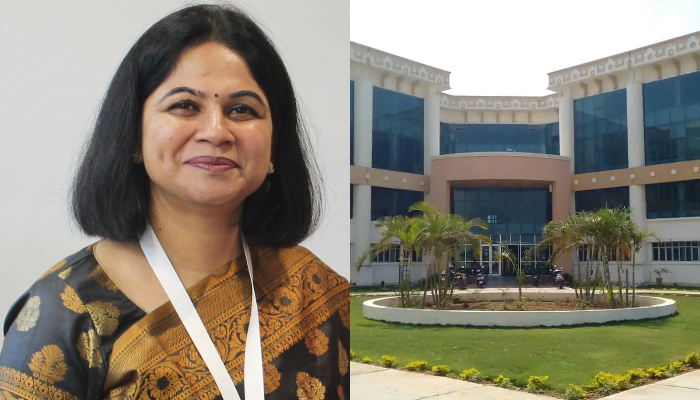
Who is Priyanka Tripathi
Priyanka Tripathi, who did her PhD (Doctor of Philosophy) from IIT Kharagpur, is an associate professor of English at IIT Patna and earlier served as the head of the Department of Humanities and Social Sciences there. She is also the Fellowship Coordinator for the Journal of International Women’s Studies produced by Bridgewater State University in the United States of America.
“Additionally, she holds the position of Associate Editor for the Journal of Graphic Novels and Comics (Taylor & Francis) and Global South Literary Studies (Taylor & Francis),” conveyed the official website.
It outlined that Tripathi has previously been awarded distinguished fellowships such as Charles Wallace India Trust Visiting Fellowship (2024-25) at the School of History, University of Leeds and IPD (Institute for Peace and Dialogue) Visiting Research Fellowship (2022-23) at Institute for Advanced Studies in the Humanities (IASH), University of Edinburgh.
The website highlighted, “Her monograph with Bloomsbury is titled The Gendered War: Evaluating Feminist Ethnographic Narratives of the 1971 War of Bangladesh (2022). Her forthcoming monograph with the National Book Trust of India is titled Mann Ki Baat & Bharatiya Art, Culture and Heritage. She works in the areas of Medical Humanities, Gender Studies, South Asian Fiction, and Graphic Novels.”
Ridiculing Hinduism under the guise of opposing patriarchy
Tripathi, with her insightful perspective, announced that Hindu men started to venerate the Shivling (the phallus) once they understood their involvement in nurturing life within the traditionally matriarchal Hindu society. Thereafter, she initiated a vitriolic discourse on the Hindu marriage system and the subjugation of women in her piece, “Women and Wounded Self: Exploring Indian Women’s Short Fiction in English.”
She expectedly invoked Hindu mythology and scriptures to prove her twisted narrative of considering women as inferior to men and relegating them to an inferior role of being dominated and subdued. These allegations which included references to feelings of anxiety with the birth of girls in the Vedic period and the treatment of the news as disastrous in the post-Vedic period, were made while engaging in a discussion about the vital subject of domestic violence.
Tripathi similarly appeared to harbour significant animosity towards the “patriarchal” Hindu society as well which she criticised while extolling the exploitative and anti-women kotha culture in “Exploring the Margins of Kotha Culture: Reconstructing a Courtesan’s Life in Neelum Saran Gour’s Requiem in Raga Janki,” which had been co-authored with Das.
The two charged, “Such othering of women is also an innate part of Hindu patriarchal societies which believe that women are unable to address their own issues of which Manusmriti, ancient text completely boasts off stating that a woman belongs to her father in childhood, to her husband in youth and in her old age she belongs to her son only (Ghosh, Manusmriti).”

The paper even declared, “Unlike Indian households where lessons of adjustment are tutored to girls, in kotha women are more familiar with taking their own decisions, reversing the constraints imposed on (Oldenburg 278),” in a startling glorification of the deeply troubled lives of the courtesans.
The IIT professor and her relationship with anti-India “Taylor & Francis”
The aforementioned is just the surface of the monstrous building that is Tripathi’s corrupt ideology and her body of work as she is clearly a habitual offender who revels in the scornful derision of Hinduism, its traditions and customs unafraid of any repercussions. She has profound ties with the United Kingdom’s Taylor & Francis, a company that has regularly disseminated anti-India and Hindu-bashing material which held “Hindu nationalist politics” also known as Hindutva accountable for supposed assaults on the Christian community.
The firm has even undermined Indian democracy as an “electoral autocracy” while admonishing the country regarding human rights asking “for adherence to, and provision of, constitutionally guaranteed rights to prevent the ongoing erosion of Indian democracy,” via another release.
It granted space to similar content which tried to interfere in the internal matters of the nation and demonised the Citizenship Amendment Act as discriminatory. Taylor & Francis’s publication did not approve of India’s sovereign approach to Ukraine and linked its strong connection with Russia to “domestic political theatre.”
Conclusion
The truth of Tripathi’s conduct has now been unveiled, however, the fact remains that she has been engaged in these antics for a long time. More importantly, the most worrying aspect is that prestigious institutions like IIT are populated with elements like her who seek to associate Hinduism with every evil in the world while simultaneously utilising it as a platform to advance their sinister agendas.
The same is apparent with the persons who have contributed to her research papers and work. Hence, this should raise concerns not only for the government but for the entire nation as its future is being shaped by individuals with such a problematic mindset.