Archaeologists discover imprints estimated to belong to a 10,000-year-old civilisation at the Sambalpur district of Odisha, ASI starts survey
In a rare discovery, archaeologists have found impressions of what they believe to be a 10,000-year-old civilisation at the Bhimmandali mountains in Redakhol, Sambalpur district of Odisha. Following the discovery, the Archaeological Survey of India (ASI) launched an extensive survey of the site on Thursday (15th January). As per reports, the ASI found several rock-cut paintings, tools, and other artefacts at 42 locations across Bhima Mandali, Raila, Landimal, and Luhapanka panchayats, and the protected forests of Chhatagada and Brahmani. The rock carvings depict imagery of animals and birds, providing a glimpse into early human artistic expression. Currently, the first phase of exploration is going on at the sites, including the historic Bhima Mandali cave. The ASI researchers are expected to stay at the cave for about two months to conduct systematic studies. Experts believe that the findings may be older than the Indus Valley Civilisations of Mohenjo-daro and Harappa. Teams of scientists from the Gangadhar Meher University and INTACH have focused on the prehistoric significance of the discovery. However, the local tradition links the site to the Mahabharata era. Image of rock carvings found at the site. (Image via Deshkal News) ASI Superintending Archaeologist DB Gadnayak described the survey work as delicate. He has been surveying with a 15-member team of experts. ASI teams surveying the site. (Image via Deshkal News) Gadnayak said that all the findings of the survey will be recorded using advanced digital documentation techniques for accuracy. “We are trying our best to make the survey better. ASI will go for digital documentation of the entire process. The survey will help turn the region into a historic place in the world. The artefacts are spread over a vast area, including hilly terrain and forests,” he said. A rock carving spotted at the site. (Image via Deshkal News) Explaining the intricacies of surveying an archaeological site, Gadnayak said that teams dig by hand instead of using heavy machinery, which significantly slows down the process. He said that the progress is only about a centimetre a day. “It is difficult to tell exactly how much time will be required for the survey. However, it may require around two months or even more than that,” the Archaeologist added. ASI member Anil Swain said that the findings so far include stone blades, needles, and scrapers used for leatherwork. “So far, we have recovered fragments of stone arrows, knives, and spears. These are clearly not modern tools; they are ancient,” Swain said. The site has over 45 rock shelters bearing inscriptions and paintings. The rock paintings were created using natural pigments made from iron oxide mixed with tree bark and leaves. The paintings and carvings depict forest environments and daily life, offering a record of their existence. A carbon dating of the site is also being conducted, as the locals and the Bhimmandal Sangha are calling for the site to be declared a National Heritage Monument. Other recent archaeological findings In June 2025, researchers from the Indian Institute of Technology Gandhinagar (IITGN), in collaboration with IIT Kanpur, IUAC Delhi, and PRL Ahmedabad, discovered firm evidence of pre-Harappan human presence in the Kachchh region of Gujarat. The study found that human settlement as old as 5,000 years before the emergence of the Harappan civilisation existed in the region. The researchers found massive heaps of discarded shells, now identified as shell middens. This indicated that prehistoric communities inhabited mangrove-dominated landscapes and consumed shell species such as oysters and gastropods. Subsequently, in July 2025, a remarkable archaeological finding emerged in Maski town in the Raichur district of Karnataka. It was estimated that humans lived in that are around 4,000 years ago. The discovery was made by scientists who were searching for additional information about the captivating location. A collaborative team of 20 researchers from India, Canada and the United States worked together to find out more about the area’s past. Researchers started excavation around Mallikarjun Hill, close to the Mallikarjuna Temple and the town’s Anjaneya Swamy temple. They came across a variety of artefacts and other tools that date back four millennia, which suggests that the area was once a vibrant settlement.
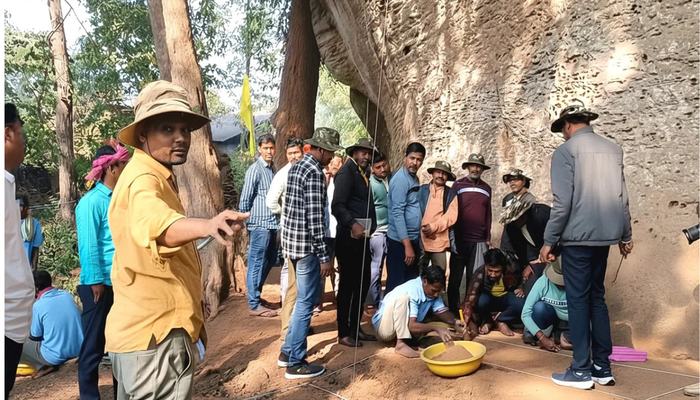

In a rare discovery, archaeologists have found impressions of what they believe to be a 10,000-year-old civilisation at the Bhimmandali mountains in Redakhol, Sambalpur district of Odisha. Following the discovery, the Archaeological Survey of India (ASI) launched an extensive survey of the site on Thursday (15th January).
As per reports, the ASI found several rock-cut paintings, tools, and other artefacts at 42 locations across Bhima Mandali, Raila, Landimal, and Luhapanka panchayats, and the protected forests of Chhatagada and Brahmani. The rock carvings depict imagery of animals and birds, providing a glimpse into early human artistic expression.
Currently, the first phase of exploration is going on at the sites, including the historic Bhima Mandali cave. The ASI researchers are expected to stay at the cave for about two months to conduct systematic studies. Experts believe that the findings may be older than the Indus Valley Civilisations of Mohenjo-daro and Harappa. Teams of scientists from the Gangadhar Meher University and INTACH have focused on the prehistoric significance of the discovery. However, the local tradition links the site to the Mahabharata era.

ASI Superintending Archaeologist DB Gadnayak described the survey work as delicate. He has been surveying with a 15-member team of experts.

Gadnayak said that all the findings of the survey will be recorded using advanced digital documentation techniques for accuracy. “We are trying our best to make the survey better. ASI will go for digital documentation of the entire process. The survey will help turn the region into a historic place in the world. The artefacts are spread over a vast area, including hilly terrain and forests,” he said.

Explaining the intricacies of surveying an archaeological site, Gadnayak said that teams dig by hand instead of using heavy machinery, which significantly slows down the process. He said that the progress is only about a centimetre a day. “It is difficult to tell exactly how much time will be required for the survey. However, it may require around two months or even more than that,” the Archaeologist added.
ASI member Anil Swain said that the findings so far include stone blades, needles, and scrapers used for leatherwork. “So far, we have recovered fragments of stone arrows, knives, and spears. These are clearly not modern tools; they are ancient,” Swain said. The site has over 45 rock shelters bearing inscriptions and paintings. The rock paintings were created using natural pigments made from iron oxide mixed with tree bark and leaves. The paintings and carvings depict forest environments and daily life, offering a record of their existence. A carbon dating of the site is also being conducted, as the locals and the Bhimmandal Sangha are calling for the site to be declared a National Heritage Monument.
Other recent archaeological findings
In June 2025, researchers from the Indian Institute of Technology Gandhinagar (IITGN), in collaboration with IIT Kanpur, IUAC Delhi, and PRL Ahmedabad, discovered firm evidence of pre-Harappan human presence in the Kachchh region of Gujarat. The study found that human settlement as old as 5,000 years before the emergence of the Harappan civilisation existed in the region. The researchers found massive heaps of discarded shells, now identified as shell middens. This indicated that prehistoric communities inhabited mangrove-dominated landscapes and consumed shell species such as oysters and gastropods.
Subsequently, in July 2025, a remarkable archaeological finding emerged in Maski town in the Raichur district of Karnataka. It was estimated that humans lived in that are around 4,000 years ago. The discovery was made by scientists who were searching for additional information about the captivating location. A collaborative team of 20 researchers from India, Canada and the United States worked together to find out more about the area’s past. Researchers started excavation around Mallikarjun Hill, close to the Mallikarjuna Temple and the town’s Anjaneya Swamy temple. They came across a variety of artefacts and other tools that date back four millennia, which suggests that the area was once a vibrant settlement.