Saurashtra–Kutch emerges as the growth engine of a developed Gujarat: Rs 5.78 lakh crores MoUs signed at Rajkot VGRC, boosting industries, jobs, and regional development
Gujarat’s land has always been known for entrepreneurship and sharp commercial acumen. When then Chief Minister Narendra Modi sowed the seeds of Vibrant Gujarat in 2003, few could have imagined that this initiative would one day grow beyond the regional level to attract investments worth trillions of rupees. The Vibrant Gujarat Regional Conference(VGRC), held in January 2026 at Marwadi University in Rajkot, has clearly demonstrated that Gujarat’s growth engine is no longer confined to metro cities alone; it has now expanded deep into the hinterlands of Saurashtra and Kutch. It is noteworthy that the 10th edition of the Vibrant Gujarat Summit was held in 2024, during which MoUs worth Rs 26.33 lakh crore were signed across 41,299 projects. Taken together, the pre-summit and summit phases attracted investments exceeding Rs 45.2 lakh crore across 98,540 projects, with the potential to generate 81 lakh jobs. The 11th edition was scheduled for 2026. However, to focus on regional development, the government decentralised the summit through regional conferences. Under this approach, the first VGRC was held in Mehsana, North Gujarat, in October 2025, followed by the Saurashtra–Kutch VGRC in Rajkot on 11–12 January 2026. The state-level summit will now be held in 2027. At the first VGRC held in October, 1,212 MoUs were signed, attracting investments worth ₹3.24 lakh crore. The recently concluded Saurashtra–Kutch VGRC focused on sectors such as the blue economy, green startups, shipbuilding, ceramics, and tourism. Rajkot—already an engineering and auto-parts hub—was connected to international markets through this summit. The conference was held at Marwadi University, located on the Rajkot–Morbi Highway, where six exhibition domes and a central innovation hall were set up across a 55-acre area. Prime Minister Narendra Modi inaugurated the conference on 11 January. Key outcomes after the conclusion of VGRC This was the first conference covering 12 districts of Kutch and Saurashtra. It saw participation from representatives of 24 countries, more than 4,000 entrepreneurs, over 450 exhibitors, and 29,000 registrations. In addition, more than 2,200 B2B and B2G meetings were held. As a result of the conference, 5,492 MoUs worth ₹5.78 lakh crore were signed. {Thread Alert}Vibrant Gujarat Regional Conference (Kutch & Saurashtra) turned vision into action,5,492 MoUs worth ₹5.78 lakh crore, 29,000+ registrations, 4,000+ entrepreneurs and Global participation from 24 countries. From MSMEs to global markets, Gujarat is…— Harsh Sanghavi (@sanghaviharsh) January 13, 2026 Sharing details in a post, Deputy Chief Minister Harsh Sanghavi stated that the following MoUs were signed: ₹381 crore across 5 MoUs in auto, engineering, and allied sectors ₹1,460 crore across 5 MoUs in the ceramics manufacturing sector ₹1,650 crore across 3 MoUs in aerospace and defence manufacturing ₹0.22 crore across 4 MoUs in skill development and MSME capacity building ₹261 crore across 13 MoUs in the blue bio-economy (biofuels, functional foods, nutraceuticals) ₹9 crore across 2 MoUs in green AI data centres and deep-tech sectors At the valedictory ceremony, Cabinet Minister Jitu Vaghani noted that during the first Vibrant Gujarat summit in 2003, only 80 MoUs worth ₹66,000 crore were signed. In contrast, this regional conference alone, held in Rajkot, concluded with 5,492 MoUs worth ₹5.78 lakh crore. These figures, along with participation from multiple countries and the unwavering trust in Prime Minister Narendra Modi, speak for themselves. He further stated that initiatives such as Atmanirbhar Bharat, Startup India, and Make in India are being realised under the Prime Minister’s leadership, directly benefiting Gujarat’s entrepreneurs and industrial units. Strategic rationale behind the government’s focus on Saurashtra and Kutch The Gujarat government is deliberately promoting Saurashtra and Kutch due to their immense potential. Gujarat has a 1,600-kilometre-long coastline, over 70% of which lies in Saurashtra and Kutch. This coastline serves as India’s gateway to global markets such as Dubai, Europe, and Africa. Compared to Ahmedabad or Surat, Saurashtra—and particularly Kutch—offers vast tracts of land, which are essential for mega projects such as solar parks and steel plants. Addressing the conference, Minister Arjun Modhwadia stated that entrepreneurship runs in the veins of the people of Kutch and Saurashtra. The government is now taking this spirit to the global stage by providing infrastructure and policy incentives. Morbi accounts for 90% of India’s ceramic production and ranks second globally. At the VGRC, this sector was showcased as a special zone, and MoUs worth Rs 1,460 crore were signed during dedicated seminars. These MoUs are not limited to setting up new factories; they are also aimed at technology upgradation. As a result, advanced technology, automation, energy efficiency, and was

Gujarat’s land has always been known for entrepreneurship and sharp commercial acumen. When then Chief Minister Narendra Modi sowed the seeds of Vibrant Gujarat in 2003, few could have imagined that this initiative would one day grow beyond the regional level to attract investments worth trillions of rupees.
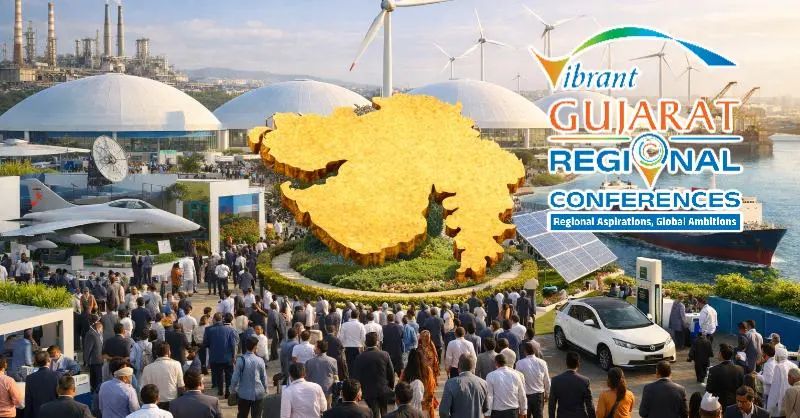
The Vibrant Gujarat Regional Conference(VGRC), held in January 2026 at Marwadi University in Rajkot, has clearly demonstrated that Gujarat’s growth engine is no longer confined to metro cities alone; it has now expanded deep into the hinterlands of Saurashtra and Kutch.
It is noteworthy that the 10th edition of the Vibrant Gujarat Summit was held in 2024, during which MoUs worth Rs 26.33 lakh crore were signed across 41,299 projects. Taken together, the pre-summit and summit phases attracted investments exceeding Rs 45.2 lakh crore across 98,540 projects, with the potential to generate 81 lakh jobs. The 11th edition was scheduled for 2026. However, to focus on regional development, the government decentralised the summit through regional conferences. Under this approach, the first VGRC was held in Mehsana, North Gujarat, in October 2025, followed by the Saurashtra–Kutch VGRC in Rajkot on 11–12 January 2026. The state-level summit will now be held in 2027.
At the first VGRC held in October, 1,212 MoUs were signed, attracting investments worth ₹3.24 lakh crore. The recently concluded Saurashtra–Kutch VGRC focused on sectors such as the blue economy, green startups, shipbuilding, ceramics, and tourism. Rajkot—already an engineering and auto-parts hub—was connected to international markets through this summit. The conference was held at Marwadi University, located on the Rajkot–Morbi Highway, where six exhibition domes and a central innovation hall were set up across a 55-acre area. Prime Minister Narendra Modi inaugurated the conference on 11 January.
Key outcomes after the conclusion of VGRC
This was the first conference covering 12 districts of Kutch and Saurashtra. It saw participation from representatives of 24 countries, more than 4,000 entrepreneurs, over 450 exhibitors, and 29,000 registrations. In addition, more than 2,200 B2B and B2G meetings were held. As a result of the conference, 5,492 MoUs worth ₹5.78 lakh crore were signed.
{Thread Alert}
— Harsh Sanghavi (@sanghaviharsh) January 13, 2026
Vibrant Gujarat Regional Conference (Kutch & Saurashtra) turned vision into action,5,492 MoUs worth ₹5.78 lakh crore,
From MSMEs to global markets, Gujarat is…
Sharing details in a post, Deputy Chief Minister Harsh Sanghavi stated that the following MoUs were signed:
- ₹381 crore across 5 MoUs in auto, engineering, and allied sectors
- ₹1,460 crore across 5 MoUs in the ceramics manufacturing sector
- ₹1,650 crore across 3 MoUs in aerospace and defence manufacturing
- ₹0.22 crore across 4 MoUs in skill development and MSME capacity building
- ₹261 crore across 13 MoUs in the blue bio-economy (biofuels, functional foods, nutraceuticals)
- ₹9 crore across 2 MoUs in green AI data centres and deep-tech sectors
At the valedictory ceremony, Cabinet Minister Jitu Vaghani noted that during the first Vibrant Gujarat summit in 2003, only 80 MoUs worth ₹66,000 crore were signed. In contrast, this regional conference alone, held in Rajkot, concluded with 5,492 MoUs worth ₹5.78 lakh crore. These figures, along with participation from multiple countries and the unwavering trust in Prime Minister Narendra Modi, speak for themselves. He further stated that initiatives such as Atmanirbhar Bharat, Startup India, and Make in India are being realised under the Prime Minister’s leadership, directly benefiting Gujarat’s entrepreneurs and industrial units.
Strategic rationale behind the government’s focus on Saurashtra and Kutch
The Gujarat government is deliberately promoting Saurashtra and Kutch due to their immense potential. Gujarat has a 1,600-kilometre-long coastline, over 70% of which lies in Saurashtra and Kutch. This coastline serves as India’s gateway to global markets such as Dubai, Europe, and Africa. Compared to Ahmedabad or Surat, Saurashtra—and particularly Kutch—offers vast tracts of land, which are essential for mega projects such as solar parks and steel plants.
Addressing the conference, Minister Arjun Modhwadia stated that entrepreneurship runs in the veins of the people of Kutch and Saurashtra. The government is now taking this spirit to the global stage by providing infrastructure and policy incentives. Morbi accounts for 90% of India’s ceramic production and ranks second globally. At the VGRC, this sector was showcased as a special zone, and MoUs worth Rs 1,460 crore were signed during dedicated seminars. These MoUs are not limited to setting up new factories; they are also aimed at technology upgradation.
As a result, advanced technology, automation, energy efficiency, and waste recycling will reduce production costs, enhance global competitiveness, and boost exports. The sector, which currently employs 10,000–12,000 people (around 60% women), will be further strengthened. New ceramic parks will drive value-added products and modern manufacturing.
From engineering to green energy
Rajkot’s engineering industry is now being integrated with “new-age technologies.” Traditionally known for pumps and auto parts, Rajkot is set to benefit from the development of a semiconductor hub, enabling local MSMEs to become part of high-tech chip manufacturing supply chains. This will allow engineering graduates to secure high-paying jobs in Rajkot itself rather than seeking opportunities abroad.
Additionally, Gujarat has set a target of developing 100 GW of renewable energy capacity by 2030. MoUs signed in this sector will significantly contribute to green hydrogen, solar, wind, and ocean energy, enhancing energy security, reducing carbon emissions, and creating thousands of skilled jobs—especially in rural areas. Rural electricity stability will improve, and new income streams will emerge. Investments in green hydrogen are expected to position Kutch as a future “energy capital.”
The coastlines of Dwarka, Somnath, and Porbandar are being developed for cruise tourism, which will boost local handicrafts, transport, and hospitality sectors. Ports in Kutch and Saurashtra serve as major gateways for India; increased exports will reduce transport costs and enhance global trade participation, promoting the blue economy and green shipping. Modern cold storage and processing units in the fisheries sector will also raise fishermen’s incomes.
Investments worth Rs 5.78 lakh crore are expected to generate approximately 12–15 lakh direct and indirect employment opportunities, curbing migration for jobs. Industrial growth will drive the development of new highways, railway connectivity, and smart cities. Rajkot’s new international airport will further accelerate this growth. Notably, whenever a large plant is established, ancillary MSMEs emerge around it, providing expanded markets for small entrepreneurs in Rajkot and Jamnagar.
The government is also establishing new skill universities and centres of excellence aligned with industry needs, ensuring that youth are job-ready. In that sense, Gujarat is no longer just vibrant; it is now regionally vibrant.