Was Rahul Gandhi’s Naravane book drama in Parliament carefully timed to counter Xi Jinping’s olive branch approach amid US attempts to manipulate India?
Yesterday, February 2, the Lok Sabha saw previously unheard of spectacles as Leader of the Opposition Rahul Gandhi tried to use the Motion of Thanks to the President’s address as a stage for sensationalism. The Congress leader attempted to recite passages from Four Stars of Destiny, the unpublished memoir of former Army Chief General MM Naravane, by waving a copy of The Caravan magazine. The House was adjourned as a result of the subsequent chaos, in which Home Minister Amit Shah and Defence Minister Rajnath Singh fiercely objected to the reference of unpublished, unverified material. Showdown in Parliament: Rahul Gandhi interrupted by Rajnath Singh as Gandhi tries to quote article on former Army Chief Naravane’s unpublished memoir on the 2020 Galwan crisis with China pic.twitter.com/xysd57rWrw— Shashank Mattoo (@MattooShashank) February 2, 2026 A far more important game is being played in the background, while the media is currently obsessed with the parliamentary theatrics, the screaming battles, the use of Rule 349, and the Congress party’s claims of censorship. To the uninformed observer, this looks like a border crisis and a personal dispute over a book. But a closer look reveals a sophisticated geopolitical ploy. The subsequent parliamentary offensive and the date of this discussion are probably not coincidental. Only a few days have passed since Beijing made a major diplomatic gesture, raising the possibility that the commotion in the well of the House might be a hint of a tectonic shift in the triangle between the US, China, and India. The theatre of the absurd: Rule 349 and the unpublished manuscript The debate appears to revolve on General Naravane’s unfinished book, notably his depiction of the August 2020 standoff on the Kailash Range. General Naravane asserts in the extracts released by The Caravan that he sought explicit political orders at crucial times when Chinese tanks were approaching Indian lines at Rechin La. After consulting with the Prime Minister, Defence Minister Rajnath Singh allegedly told him, ‘Jo uchit samjho, woh karo’ (Do whatever you feel proper). This phrase has been seized upon by the opposition, who saw it as the political leadership’s abdication of responsibility and a moment of hesitancy when the country needed clear directives. Rahul Gandhi tried to use this narrative yesterday to portray the government as weak and unsure of itself. But the defence minister himself spearheaded the government’s counteroffensive, which was grounded in both operational need and rigorous parliamentary decorum. Members of the Lok Sabha are strictly prohibited from reading books, newspapers, or letters that are not directly related to the particular topic under discussion in the House, as per Rule 349. To put it another way, the purpose of this rule is to make sure that the floor of Parliament is used for official legislative work rather than for promoting unsubstantiated claims or private manuscripts that haven’t been legally placed on the table. Rajnath Singh’s argument was clear how can the sanctity of Parliament be compromised by citing from a book that is not officially in the public domain? The Ministry of Defence (MoD) is presently reviewing the manuscript as per rules, according to the government’s position. Contrary to what the opposition says, this is a standard, non negotiable protocol rather than censorship. Service chief memoirs must be sanitised for sensitive information that can jeopardize military strategies or intelligence sources, particularly those that deal with current and ongoing operational realities like the LAC standoff. The Opposition was essentially asking the House to circumvent national security procedures in order to make a political soundbite by trying to put these unverified passages into the parliamentary record. Furthermore, interpreting the order ‘Jo uchit samjho, woh karo’ as indecision is a serious misunderstanding of military command structures. Delegating operational flexibility to the commander on the field is frequently the highest form of political leadership during a tactical crisis. The political leadership was empowering, not deserting, the Army by granting General Naravane the carte blanche to do as deemed appropriate. The commanders were free to respond to the changing dynamics of the battlefield without being constrained by a distant bureaucracy in Delhi, as it was a mark of confidence in the military’s judgment. The narrative of the opposition deliberately overlooks the fact that this choice ultimately resulted in the successful occupation of the heights, compelling China to engage in negotiations. Xi’s greeting and the American anxiety It is necessary to look outside the boundaries of Parliament and toward the diplomatic cables that were exchanged just last week in order to fully comprehend why this dispute has now emerged. Something unexpected occurred on Republic Day, January 26, 2026. In contrast to
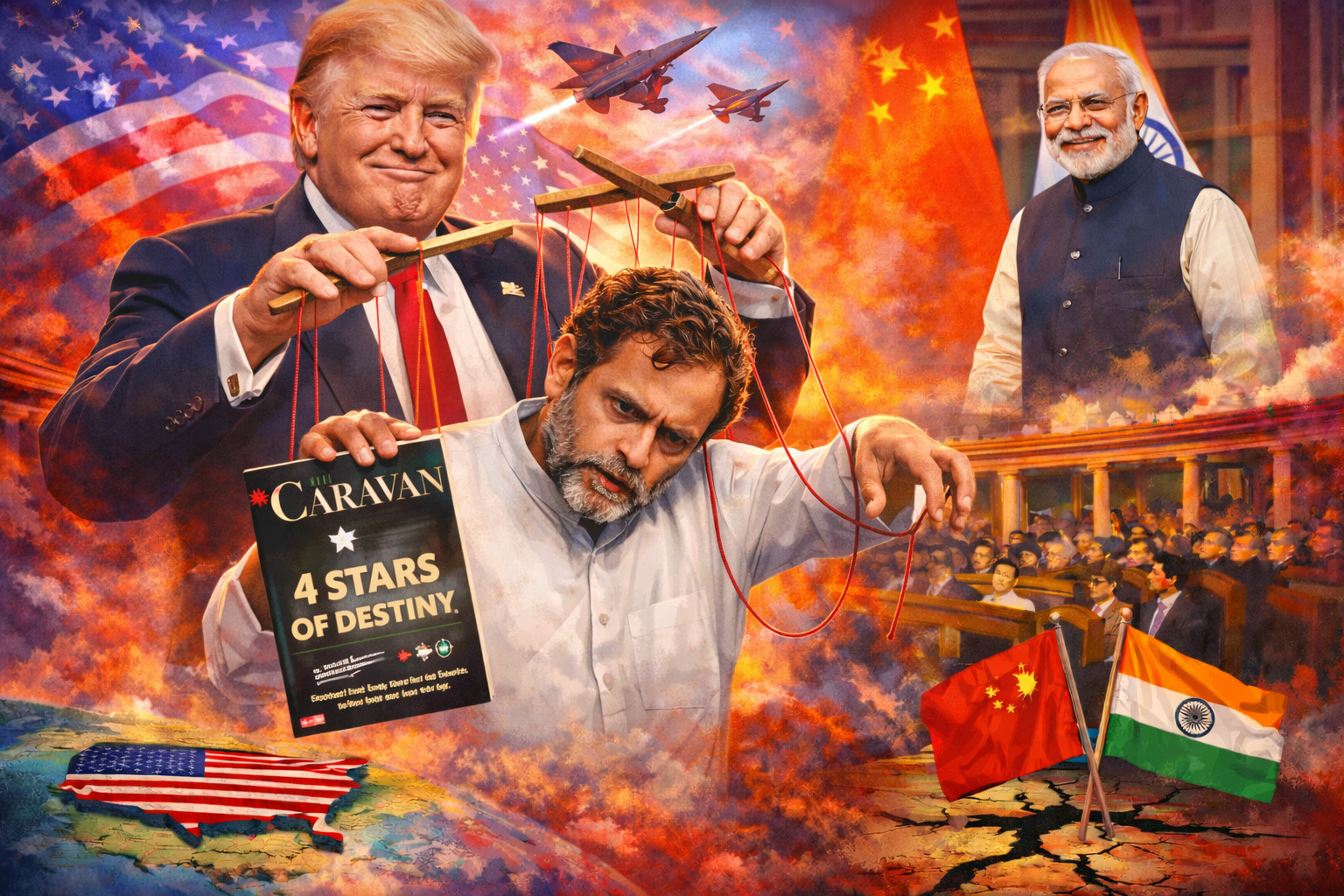

Yesterday, February 2, the Lok Sabha saw previously unheard of spectacles as Leader of the Opposition Rahul Gandhi tried to use the Motion of Thanks to the President’s address as a stage for sensationalism. The Congress leader attempted to recite passages from Four Stars of Destiny, the unpublished memoir of former Army Chief General MM Naravane, by waving a copy of The Caravan magazine. The House was adjourned as a result of the subsequent chaos, in which Home Minister Amit Shah and Defence Minister Rajnath Singh fiercely objected to the reference of unpublished, unverified material.
Showdown in Parliament: Rahul Gandhi interrupted by Rajnath Singh as Gandhi tries to quote article on former Army Chief Naravane’s unpublished memoir on the 2020 Galwan crisis with China pic.twitter.com/xysd57rWrw
— Shashank Mattoo (@MattooShashank) February 2, 2026
A far more important game is being played in the background, while the media is currently obsessed with the parliamentary theatrics, the screaming battles, the use of Rule 349, and the Congress party’s claims of censorship. To the uninformed observer, this looks like a border crisis and a personal dispute over a book. But a closer look reveals a sophisticated geopolitical ploy. The subsequent parliamentary offensive and the date of this discussion are probably not coincidental. Only a few days have passed since Beijing made a major diplomatic gesture, raising the possibility that the commotion in the well of the House might be a hint of a tectonic shift in the triangle between the US, China, and India.
The theatre of the absurd: Rule 349 and the unpublished manuscript
The debate appears to revolve on General Naravane’s unfinished book, notably his depiction of the August 2020 standoff on the Kailash Range. General Naravane asserts in the extracts released by The Caravan that he sought explicit political orders at crucial times when Chinese tanks were approaching Indian lines at Rechin La. After consulting with the Prime Minister, Defence Minister Rajnath Singh allegedly told him, ‘Jo uchit samjho, woh karo’ (Do whatever you feel proper).
This phrase has been seized upon by the opposition, who saw it as the political leadership’s abdication of responsibility and a moment of hesitancy when the country needed clear directives. Rahul Gandhi tried to use this narrative yesterday to portray the government as weak and unsure of itself. But the defence minister himself spearheaded the government’s counteroffensive, which was grounded in both operational need and rigorous parliamentary decorum.
Members of the Lok Sabha are strictly prohibited from reading books, newspapers, or letters that are not directly related to the particular topic under discussion in the House, as per Rule 349. To put it another way, the purpose of this rule is to make sure that the floor of Parliament is used for official legislative work rather than for promoting unsubstantiated claims or private manuscripts that haven’t been legally placed on the table.
Rajnath Singh’s argument was clear how can the sanctity of Parliament be compromised by citing from a book that is not officially in the public domain? The Ministry of Defence (MoD) is presently reviewing the manuscript as per rules, according to the government’s position. Contrary to what the opposition says, this is a standard, non negotiable protocol rather than censorship. Service chief memoirs must be sanitised for sensitive information that can jeopardize military strategies or intelligence sources, particularly those that deal with current and ongoing operational realities like the LAC standoff. The Opposition was essentially asking the House to circumvent national security procedures in order to make a political soundbite by trying to put these unverified passages into the parliamentary record.
Furthermore, interpreting the order ‘Jo uchit samjho, woh karo’ as indecision is a serious misunderstanding of military command structures. Delegating operational flexibility to the commander on the field is frequently the highest form of political leadership during a tactical crisis. The political leadership was empowering, not deserting, the Army by granting General Naravane the carte blanche to do as deemed appropriate. The commanders were free to respond to the changing dynamics of the battlefield without being constrained by a distant bureaucracy in Delhi, as it was a mark of confidence in the military’s judgment. The narrative of the opposition deliberately overlooks the fact that this choice ultimately resulted in the successful occupation of the heights, compelling China to engage in negotiations.
Xi’s greeting and the American anxiety
It is necessary to look outside the boundaries of Parliament and toward the diplomatic cables that were exchanged just last week in order to fully comprehend why this dispute has now emerged.
Something unexpected occurred on Republic Day, January 26, 2026. In contrast to the routine diplomatic correspondence of other years, Chinese President Xi Jinping sent President Droupadi Murmu a message. As ‘good neighbors, friends, and partners,’ Xi compared China and India to a ‘dragon and the elephant dancing together.’ This was a clear signal in the complex realm of Chinese diplomacy, not merely polite conversation. Beijing was indicating that it was prepared for a thaw after years of freezing after the Galwan conflict.
The Atlanticist establishment’s worst-case scenario is the possible normalisation of relations between China and India, the two titans of Asia. India’s role as China’s long-term counterweight in the Indo-Pacific is crucial to the United States, which is currently preoccupied with its own internal changes and international obligations. The containment approach Washington has painstakingly developed over the past ten years would be undermined by a détente between Beijing and New Delhi.
In light of this, the abrupt appearance of the Naravane extracts in The Caravan, a newspaper renowned for its prejudiced stance on the current Indian regime and its frequent agreement with narratives popular in Western liberal circles, raises questions. The goal of the leak of the memoir passages at this particular time is to sabotage any quiet diplomatic progress with Beijing by rekindling domestic resentment against China and putting the Indian government in a difficult position where it must speak forcefully to defend its nationalist credentials.
Is it a coincidence that a 2020 problem is brought up to stoke popular anger at the same time that Xi Jinping is offering an olive branch? Here, the foreign hand might be a sophisticated information operation rather than the naked intrusion of the Cold War era. Interests supporting the American Deep State can successfully drive a wedge by using a domestic outlet and a willing opposition. They are aware that Prime Minister Modi’s administration will find it politically impossible to accept Beijing’s handshake if the Parliament is immobilized by charges of surrender to China. The dispute keeps India tightly bound to the US security framework by guaranteeing that the China threat will continue to be the most prevalent domestic narrative.
The hypocrisy of alleging censorship: A memory lapse?
When compared to historical events, the Congress party’s recent defense of freedom of expression with relation to military novels seems hollow. The Opposition seems to have forgotten its own history of stifling military voices that went against the Nehru-Gandhi heritage when it accused the government of gagging General Naravane.
Brigadier J.P. Dalvi’s Himalayan Blunder was notably banned by the Congress government. That book revealed the negligence of the political leadership at the time and was a scathing first hand account of the 1962 fiasco. In a similar vein, Neville Maxwell’s book India’s China War, which questioned the official Indian account of the 1962 war, was threatened with legal action under the Official Secrets Act. Even Bertrand Russell’s Unarmed Victory, authored by one of the world’s most prominent philosophers, was banned in India because it criticized the government’s handling of the Sino Indian border issue.
It is astoundingly hypocritical of a party that methodically repressed any military writers who dared to criticize the 1962 defeat to now claim censorship over a routine security evaluation of a contemporary book. The opposition naively ignores the fact that the current government is not outlawing books rather, it is making sure that operational details are kept secret.
The agnipath dimension and the attempt to divide the forces
The attempt to rekindle the wounds related to the Agnipath program through General Naravane’s memoir is another facet of this dispute. The Army was allegedly surprised by the scheme’s implementation, according to the leaked passages.
The Opposition wants to create a rift between the military and the political establishment by drawing attention to this. This is a risky game. Civil military interactions are sacred in a democracy. The civilian leadership is ultimately in charge of making decisions. They consult with the military but base their choices on a wider range of national considerations, such as long term strategy and economics. To imply that the Army was bypassed would encourage disobedience and distrust among the ranks.
Again, timing is critical in this situation. The initial groups of Agniveers have already been integrated into units as the Agnipath plan has stabilized. It is an attempt to undermine military unity at a time when the borders are still tense by bringing up this topic now. It fits in well with the goals of foreign enemies who stand to gain from an Indian military that is divided on the inside and wary of its political overlords.
The hypocrisy of citing ‘National Security‘
It was evident how ironic yesterday’s events were. Although Rahul Gandhi claimed to advocate for national security and the truth, in reality, he was using live television to expose the tactical specifics of a delicate border deployment and decision making process, curiously timed for a moment when China is extending a handshake. The passages describe the precise locations of commanders, the movement of tanks, and the time of calls.
The LAC is in a stable but precarious state in 2026. The PLA (People’s Liberation Army) gains vital information on India’s crisis response time and political command loops by disclosing the detailed decision matrix of 2020, including how long it took for orders to arrive and what the precise instructions were. The Opposition is unintentionally serving as an open source intelligence resource for the very enemy they allege the administration is mismanaging by advocating for the public release of these facts.
The government’s silence over the book’s specifics is a responsible state’s discipline rather than an admission of guilt. Post mortems of near war situations are not held in public squares by states when the neighbour is still observing from the ridgeline. In order to keep the Lok Sabha from becoming a weakness in India’s defense posture, the Defence Minister’s intervention served as a crucial firewall.
Conclusion
It is critical that the Indian public grasp the bigger picture as the shouting match in Parliament comes to a close. The Naravane Controversy is not primarily about what transpired on the evening of August 31, 2020, nor is it particularly about a book. India triumphed that night because our political leadership trusted the Army to do its duty, our men secured the heights, and our tanks faced down the PLA.
The true narrative of February 2, 2026, is about the precarious equilibrium of geopolitics in the twenty-first century. We are seeing a deliberate attempt to sabotage a possible normalisation of relations between China and India. To keep the Himalayan borders hot, the Western Lobby, with the help of a domestic media outlet and an opportunistic opposition, is using information warfare. The commotion in Parliament is an attempt to close the door that Xi Jinping’s Republic Day greeting opened. India’s strategic autonomy cannot be dictated by foreign interests or domestic sensationalism, as demonstrated by the government’s failure to respond to the leaked documents.
Who gains from portraying the Indian Army as leaderless and the government as weak? Not India and most definitely not the soldiers on duty at Rechin La. Only those who are afraid of an India that is confident and at peace with its neighbors stand to gain.