‘India is the second largest market for Claude, developers here doing the most intense work’: As India hosts AI Impact Summit, global giant Anthropic opens office
As India hosts the AI Impact Summit 2026 in Delhi, US-based AI company Anthropic has officially opened its new office in Bengaluru, marking a major step in its India AI expansion. Along with the office launch, the company has announced a wide range of partnerships across enterprise, startups, education, agriculture and the public sector. #TechToday | Anthropic opens new office in Bengaluru, announces partnerships across India https://t.co/289pblQqhj— Business Today (@business_today) February 16, 2026 The Bengaluru office is Anthropic’s second base in Asia after Tokyo and will be led by Irina Ghose, Managing Director of Anthropic India. The company plans to hire local talent across multiple roles as it deepens its engagement in the country. India has quickly become one of the most important markets for Claude.ai, Anthropic’s popular AI assistant. The company says India is now its second-largest market globally. Nearly half of Claude’s usage in India comes from technical work such as coding, mathematical tasks, building applications, upgrading legacy systems and shipping production software, Anthropic says. This shows how Indian developers are using AI tools not just for content or chat, but for serious engineering work. Speaking about the expansion, Irina Ghose said India offers a strong foundation for responsible AI. She pointed to the country’s technical talent, large-scale digital infrastructure and its track record of using technology to improve everyday life. According to her, this combination makes India one of the most promising places in the world to expand the benefits of AI to more people and businesses. “Impossible things are possible in India”: Rahul Patil At the developer summit marking the office launch, Anthropic’s Chief Technology Officer, Rahul Patil, shared a personal message that resonated with many in the audience. He said, “Impossible things are possible in India,” as he spoke about growing up in Bengaluru. Rahul Patil, CTO, Anthropic draws on his Indian and Bengaluru roots while kicking off the developer summit Impossible things are possible in IndiaI was born and brought up in Bengaluru My mom was a computer science teacherStudied in Baldwin, Joseph and PES University PES… pic.twitter.com/5W1tiJEv9U— Chandra R. Srikanth (@chandrarsrikant) February 16, 2026 Patil said his mother was a computer science teacher and that he studied at Baldwin institutions, St. Joseph’s and later at PES University, which he described as “very, very strict.” He also shared that he met his wife during his first year of engineering. His speech highlighted how India has not only become a key market for AI but also a place that has shaped global tech leaders. Strengthening AI in Indian Languages One of Anthropic’s key focus areas in India is language. Although more than a billion people in the country speak one of over a dozen officially recognised languages, AI systems often perform better in English, Anthropic stated. To address this, Anthropic started a company-wide effort six months ago to improve performance in ten widely spoken Indian languages: Hindi, Bengali, Marathi, Telugu, Tamil, Punjabi, Gujarati, Kannada, Malayalam and Urdu. The company says it curated better and more representative training data, leading to noticeable improvements in fluency. Work is still ongoing to make the models even stronger in Indic languages. Anthropic is also working with Karya and Collective Intelligence Project to design evaluation systems that test AI on tasks relevant to India, especially in agriculture and law. Domain experts from nonprofits such as Digital Green and Adalat AI are part of this effort. The goal is to make these evaluation tools publicly available so others can also build better AI systems for Indian users. Enterprises and startups adopt Claude at scale Anthropic says its revenue run rate in India has doubled since it announced expansion plans in October 2025. The growth is coming from large enterprises, digital-first companies and early-stage startups. Air India is using Claude Code to help its developers ship custom software faster and at lower cost as part of a broader effort to use agent-based AI across operations. Fintech platform CRED has reported 2x faster feature delivery and 10% improvement in test coverage with Claude Code. Meanwhile, global IT services firm Cognizant is deploying Claude to 350,000 employees worldwide to modernise systems and speed up AI adoption for enterprise clients, as per reports. Among startups, Razorpay has integrated AI into its risk systems, operations and internal decision-making. Enterpret uses Claude to power its AI assistant and has built an MCP integration that connects customer insights directly into Claude. Another startup, Emergent, which allows users to create software by describing what they want in simple language, reached $25 million in annual recurring revenue and two million users in less than fi
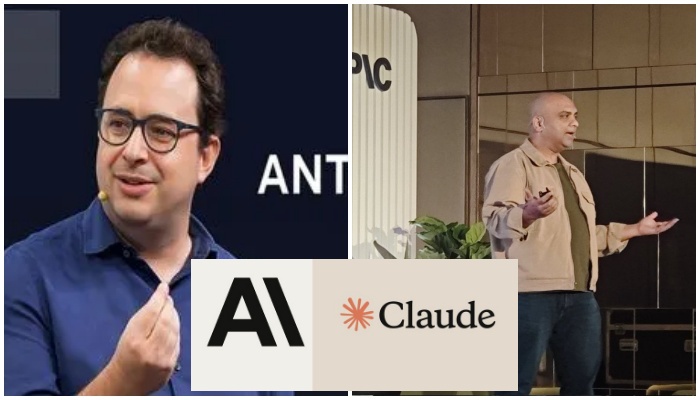

As India hosts the AI Impact Summit 2026 in Delhi, US-based AI company Anthropic has officially opened its new office in Bengaluru, marking a major step in its India AI expansion. Along with the office launch, the company has announced a wide range of partnerships across enterprise, startups, education, agriculture and the public sector.
#TechToday | Anthropic opens new office in Bengaluru, announces partnerships across India https://t.co/289pblQqhj
— Business Today (@business_today) February 16, 2026
The Bengaluru office is Anthropic’s second base in Asia after Tokyo and will be led by Irina Ghose, Managing Director of Anthropic India. The company plans to hire local talent across multiple roles as it deepens its engagement in the country.
India has quickly become one of the most important markets for Claude.ai, Anthropic’s popular AI assistant. The company says India is now its second-largest market globally.
Nearly half of Claude’s usage in India comes from technical work such as coding, mathematical tasks, building applications, upgrading legacy systems and shipping production software, Anthropic says. This shows how Indian developers are using AI tools not just for content or chat, but for serious engineering work.
Speaking about the expansion, Irina Ghose said India offers a strong foundation for responsible AI. She pointed to the country’s technical talent, large-scale digital infrastructure and its track record of using technology to improve everyday life. According to her, this combination makes India one of the most promising places in the world to expand the benefits of AI to more people and businesses.
“Impossible things are possible in India”: Rahul Patil
At the developer summit marking the office launch, Anthropic’s Chief Technology Officer, Rahul Patil, shared a personal message that resonated with many in the audience. He said, “Impossible things are possible in India,” as he spoke about growing up in Bengaluru.
Rahul Patil, CTO, Anthropic draws on his Indian and Bengaluru roots while kicking off the developer summit
— Chandra R. Srikanth (@chandrarsrikant) February 16, 2026
Impossible things are possible in India
I was born and brought up in Bengaluru
My mom was a computer science teacher
Studied in Baldwin, Joseph and PES University
PES… pic.twitter.com/5W1tiJEv9U
Patil said his mother was a computer science teacher and that he studied at Baldwin institutions, St. Joseph’s and later at PES University, which he described as “very, very strict.” He also shared that he met his wife during his first year of engineering. His speech highlighted how India has not only become a key market for AI but also a place that has shaped global tech leaders.
Strengthening AI in Indian Languages
One of Anthropic’s key focus areas in India is language. Although more than a billion people in the country speak one of over a dozen officially recognised languages, AI systems often perform better in English, Anthropic stated.
To address this, Anthropic started a company-wide effort six months ago to improve performance in ten widely spoken Indian languages: Hindi, Bengali, Marathi, Telugu, Tamil, Punjabi, Gujarati, Kannada, Malayalam and Urdu. The company says it curated better and more representative training data, leading to noticeable improvements in fluency. Work is still ongoing to make the models even stronger in Indic languages.
Anthropic is also working with Karya and Collective Intelligence Project to design evaluation systems that test AI on tasks relevant to India, especially in agriculture and law. Domain experts from nonprofits such as Digital Green and Adalat AI are part of this effort. The goal is to make these evaluation tools publicly available so others can also build better AI systems for Indian users.
Enterprises and startups adopt Claude at scale
Anthropic says its revenue run rate in India has doubled since it announced expansion plans in October 2025. The growth is coming from large enterprises, digital-first companies and early-stage startups.
Air India is using Claude Code to help its developers ship custom software faster and at lower cost as part of a broader effort to use agent-based AI across operations. Fintech platform CRED has reported 2x faster feature delivery and 10% improvement in test coverage with Claude Code. Meanwhile, global IT services firm Cognizant is deploying Claude to 350,000 employees worldwide to modernise systems and speed up AI adoption for enterprise clients, as per reports.
Among startups, Razorpay has integrated AI into its risk systems, operations and internal decision-making. Enterpret uses Claude to power its AI assistant and has built an MCP integration that connects customer insights directly into Claude.
Another startup, Emergent, which allows users to create software by describing what they want in simple language, reached $25 million in annual recurring revenue and two million users in less than five months, built entirely with Claude.
To support this growing ecosystem, Anthropic’s India team will provide applied AI expertise to enterprises and startups, helping them design and scale Claude-based solutions suited to their business needs.
AI for education and underserved communities
Education-related tasks account for about 12% of Claude’s usage in India. Anthropic has partnered with Pratham, one of the country’s largest education nonprofits. Pratham selected Anthropic as its first strategic AI lab partner, focusing on safety and educational quality.
Their “Anytime Testing Machine,” powered by Claude, is currently being tested with 1,500 students across 20 schools and is expected to expand to 100 schools by the end of 2026. The tool has also been adapted for more than 5,000 learners in Pratham’s Second Chance program, which supports women who dropped out of formal schooling. The idea is to provide flexible exam preparation and credible certification pathways.
Anthropic is also working with Central Square Foundation to support AI-enabled tools such as personalised tutors, teacher coaching platforms and assessment-based instruction systems. The company will offer technical support, mentorship and API credits to help these tools reach more primary school students in underserved communities.
AI in agriculture, health and the legal system
India’s digital public infrastructure has often been seen as a model for large-scale, interoperable systems. Anthropic is partnering with EkStep Foundation to explore how AI can build on this foundation.
Agriculture, which contributes nearly one-sixth of India’s economy and employs almost half of its workforce, is one focus area. Through the OpenAgriNet effort, Anthropic is working towards deploying Claude to expand access to expert knowledge for farmers and agriculture workers.
In healthcare, nonprofits like Noora Health and Intelehealth are exploring how Claude Code and Cowork can improve internal systems and connect patients in remote areas to better care.
India’s legal system, with around 50 million pending court cases, is another area where AI can make a difference. Anthropic is supporting Adalat AI in launching a national WhatsApp helpline that provides instant case updates, document summaries, translations and interactive legal queries in Indian languages.
The company has also promoted open standards through its Model Context Protocol, which it donated to the Linux Foundation. The Ministry of Statistics and Programme Implementation, supported by Bharat Digital, has launched the first Indian government MCP server to allow AI systems to access national statistics in an open way. In the private sector, Swiggy is using MCP to enable grocery ordering and dining reservations directly through Claude.
Why global AI giants are choosing India
Anthropic’s expansion is part of a larger trend. Over the past two years, global AI companies have increasingly invested in India for research, partnerships and market expansion.
Companies like OpenAI and Microsoft have deepened their India presence through research collaborations, cloud partnerships and developer initiatives. Google has also expanded its AI research and product rollouts tailored for Indian users.
India offers three major advantages. First, it has one of the world’s largest developer bases. Second, its digital public infrastructure, including large-scale identity and payments systems, allows AI tools to scale quickly. Third, the country’s diversity of languages and real-world use cases provides a strong testing ground for AI models.
India’s AI market is expected to grow rapidly and contribute significantly to the country’s digital economy over the coming years.
As Anthropic opens its Bengaluru office, it is clear that India is no longer just a consumer of global AI technology. It is becoming a core partner in building and shaping the next wave of AI innovation.